

You’ve built a strong business.
You’re turning over $5–10 million annually, your team has grown to 30–40 people, and from the outside, things look successful. But internally, day-to-day operations feel harder than they should.
Finance spends too much time reconciling spreadsheets that never quite match. Inventory numbers are questioned more than trusted. When leadership asks, “Which products or customers are most profitable?”, the answer isn’t immediate — it’s buried somewhere in Excel.
This is the point where many Australian SMEs hit the Excel ceiling. What once worked well now limits visibility, control, and growth.
Why Spreadsheet-Based Operations Start Holding You Back
Spreadsheets aren’t the problem; scale is.
As your transaction volumes increase, spreadsheet-based processes create duplication, manual errors, and delays. Data gets entered multiple times by different teams. Reporting becomes reactive instead of real-time. Over time, trust in the numbers erodes.
Common symptoms we see include:
- Hours each week spent reconciling data across systems
- Finance, sales, and operations maintain their own “versions” of the truth
- Slow month-end close driven by manual adjustments
- Decisions made without clear, current data
ERP replaces this fragmentation with a single system and a single source of truth, allowing leaders to act with confidence rather than on assumptions.
A Real Australian Example: The Impact of Switching to Odoo
An electrical wholesaler in Sydney came to Envertis with this exact challenge.
With 42 employees, two warehouses, and $8.5 million in annual revenue, they were running MYOB alongside dozens of Excel spreadsheets. Month-end close regularly took eight business days, and their finance manager spent nearly half the week simply pulling data together.
Within six months of implementing Odoo ERP, the business saw measurable change:
- Month-end close reduced from 8 days to 2 days
- Finance administration time cut by 75%
- Inventory accuracy improved from 76% to 98%
- Stockouts reduced by more than 80%
- Real-time profitability available by product, customer, and warehouse
Financially, the business saved over $60,000 per year in administrative effort and released $180,000 in excess inventory once visibility improved. The system paid for itself in under a year.
Just as importantly, the team began trusting the data, which fundamentally changed how decisions were made.
What Odoo Actually Does for Growing Businesses
Odoo is not just accounting software. It’s a fully integrated business platform that replaces disconnected tools and spreadsheets with a single system.
Instead of managing separate systems for CRM, accounting, inventory, and projects, Odoo brings everything together.
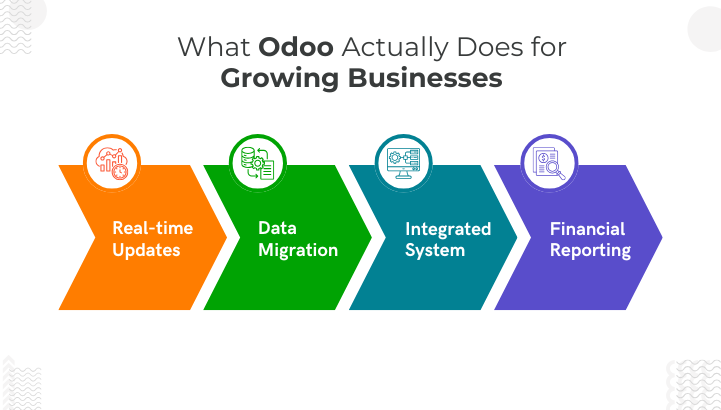
In practice, this means:
- Sales, inventory, purchasing, and finance all update in real time
- Data is entered once and used everywhere
- Reporting is live, not retrospective
For manufacturers, bills of materials, purchasing, production, and costing stay automatically aligned. For wholesalers and distributors, sales teams can confirm stock, margins, and delivery timelines while still speaking with customers. For professional services firms, time tracking flows directly into project costing, billing, and financial reporting — without re-keying or reconciliation.
The result is clarity, control, and confidence at scale.
When is the Right Time to Move from Excel to Odoo?
Most businesses wait too long.
You should seriously consider ERP if three or more of the following apply:
- Teams spend hours each week maintaining the same data in multiple places
- Finance, sales, and operations re-enter the same information repeatedly
- Simple questions about cash, inventory, or margins can’t be answered instantly
- Month-end close takes more than three business days
If this sounds familiar, the cost of waiting is already showing up in lost time and missed opportunities.
Why Envertis is the Right Odoo Partner in Australia
Odoo is powerful — but ERP success depends on how it’s implemented.
Envertis specialises in Odoo implementations for Australian SMEs, with a focus on outcomes, not complexity. We don’t force businesses into rigid templates or overengineered solutions. Instead, we start with how your business actually operates and configure Odoo to support those workflows.
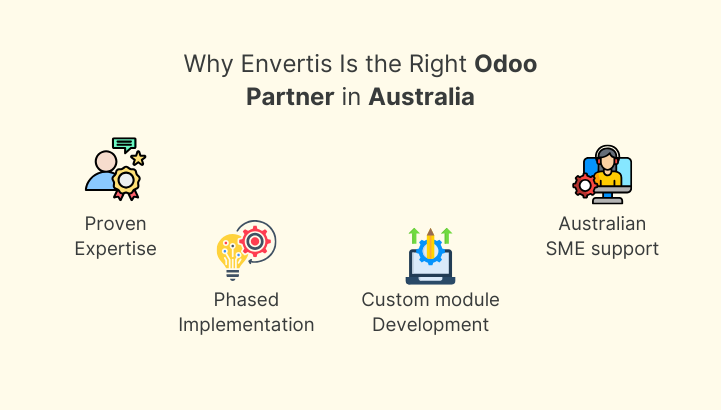
What sets Envertis apart:
- Deep experience with growing Australian SMEs
- Phased implementations that deliver early ROI
- Practical configurations aligned to real-world operations
- Strong focus on adoption, not just go-live
We prioritise the modules that matter most first, stabilise the system, and then expand as your business grows. This approach reduces risk, accelerates user adoption, and ensures the system delivers measurable value quickly.
What Implementation Looks Like
For most Australian SMEs, core Odoo modules can be implemented within 8–16 weeks, with additional functionality rolled out over time.
Costs remain predictable through Odoo’s modular, per-user pricing model. When implemented correctly, most businesses recover their investment within 12–18 months through efficiency gains, improved stock control, and better decision-making.
Ready to See What This Means for Your Business?
If Excel is holding your operations together today, it will eventually hold back your growth.
A structured ERP journey — supported by a local expert — replaces operational stress with visibility and control.

No pressure. Just clear answers, real numbers, and a roadmap designed around your business.
