
It starts with one spreadsheet.
Then it becomes two spreadsheets.
Then there is a shared Google Sheet that team members update at different times.
In a situation where a consumer requests the status of their purchase, no one can provide a clear response because the number in Shopify differs from the number in your warehouse system, which in turn differs from what the accounts department was informed of last Tuesday.
Does that sound familiar?
The fix isn’t more staff, more spreadsheets, or more workarounds. It’s a properly executed Odoo ERP integration that connects your Shopify store to a system built to handle the operational complexity your business has grown into.
This blog covers exactly what that integration does, what you need to get right before and during implementation.
Challenges of Running Shopify Without a Centralised Business Management System (ERP)
Here’s what nobody talks about in the eCommerce growth you see everywhere. Growing a Shopify store without proper back-end infrastructure doesn’t just create inefficiency; it creates compounding risk.
Every manual process is a potential failure point. Every disconnected system is a source of data drift. And data drift, left unchecked, quietly erodes the things your business depends on.
The operational pain points that drive most Australian businesses toward Shopify order management and Odoo Shopify integration follow a predictable pattern, like:
- Inventory figures that can’t be trusted
Without real-time inventory synchronisation between Shopify and your warehouse, overselling becomes a matter of when, not if. Every peak sales period amplifies the risk.
- Manual re-entry that scales badly
Copying order data from Shopify into your accounting or fulfilment system works at nearly 20 orders a day. It breaks down at 200 and becomes a full-time job at 2,000.
- Order delays caused by human handoffs
When fulfilment or order automation systems rely on someone manually acting on a Shopify notification, any disruption to that chain can affect them. A missed email, a sick team member, or a busy period creates customer-facing delays.
- Wrong reporting
When sales data lives in Shopify and financial details live elsewhere, the numbers never quite agree. Decisions made on incomplete data are only as good as the data itself.
All of the above are signs of a poorly run business without any multi-channel sales integration. They’re signs of a business that has grown faster than its infrastructure before being addressed.
Why Australian Businesses Are Turning to Odoo integration with Shopify Store
Shopify’s supremacy in the Australian eCommerce business is not unavoidable. It is easy to set up and run, and it can manage substantial revenue through social, mobile, and virtual channels. Moreover, for businesses at early and mid-stage growth, it does the job exceptionally well.
But Shopify is a commerce platform, not an operations platform. It was not intended to operate an enterprise from start to finish, but rather to sell. Additionally, voids in that model are more costly as order volumes rise, product catalogues grow, and customer expectations increase.
That’s the opening Odoo eCommerce integration is built to fill.
Odoo is a modular, open-source ERP that covers inventory management, procurement, accounting, CRM, manufacturing, and more, everything within a single, configurable system. For Shopify businesses, Odoo provides what Shopify deliberately doesn’t.
The eCommerce ERP integration argument is strongest for Australian businesses navigating local complexities, GST compliance, AUD multi-currency requirements, domestic and international freight management, and the market’s operational demands. A generic SaaS stack can’t always accommodate that nuance. A properly implemented Odoo integration can.
How Shopify & Odoo Integration Actually Works for eCommerce Businesses
The technical connection between Shopify and Odoo is achievable. Numerous organisations have previously done it.
The quality of the strategic and architectural choices made before writing a single line of configuration. This is what distinguishes integrations that provide continuous benefit from those that become recurring problems.
Here is what deserves serious attention when you integrate Odoo for Shopify businesses:
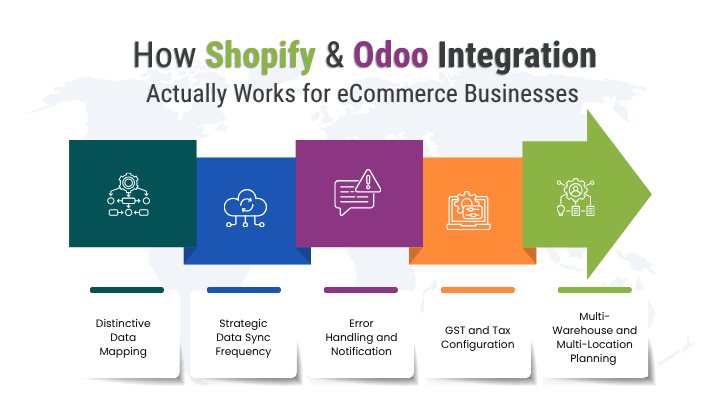
- Distinctive Data Mapping
Every field that crosses the integration boundary needs to be mapped deliberately and precisely.
What does “product SKU” mean in Shopify versus Odoo? How should Shopify discount logic translate into Odoo’s pricing rule structure? How are customer records deduplicated when the same buyer appears in both systems?
Poorly mapped data doesn’t cause obvious failures. It causes subtle, persistent inaccuracies that compound over time and are expensive to trace back to their source.
- Strategic Data Sync Frequency
Could inventory be synchronised in batches or in real-time? Real-time sync is ideal for high-volume storage, but it necessitates more precise infrastructure organisation. Scheduled batch sync is sufficient and easier to manage for lower-volume processes.
Performance and data integrity are affected by the strategic choice of what initiates a sync and by the circumstances under which it should be halted or overridden.
- Error Handling and Notification
Every production integration encounters edge cases: duplicate records, failed API calls, out-of-stock fulfilment attempts, and partial order updates.
Building in robust error handling and clear alerting protocols from day one means issues are caught and resolved before they reach customers, rather than discovered after complaints arrive.
- GST and Tax Configuration
Australian tax logic must be configured correctly from the outset. Odoo supports Australian GST natively, but mapping Shopify’s tax settings to Odoo’s tax rules requires deliberate setup.
Especially for businesses selling across product categories with different tax treatments, or managing both B2C and B2B transactions with different tax obligations.
- Multi-Warehouse and Multi-Location Planning
Shopify Odoo integration for inventory and orders strategy must take this into account from the outset if your business operates across several fulfilment sites or intends to expand in that direction.
It is disruptive and expensive to retrofit multi-warehouse logic into a single-location implementation. If there’s any possibility of future expansion, we can scope it now.
Proper Odoo ERP implementation planning builds in performance headroom and avoids the scenario where a successful peak sales period exposes architectural limits you didn’t know you had.

Technical Benefits of Shopify Odoo Integration for Businesses: How Envertis Can Help You
Developers build technical integrations. But business outcomes justify them, and those outcomes are what decision-makers need to see clearly before committing.
When the benefits of Shopify Odoo integration for businesses are realised properly, the impact shows up in several measurable ways:
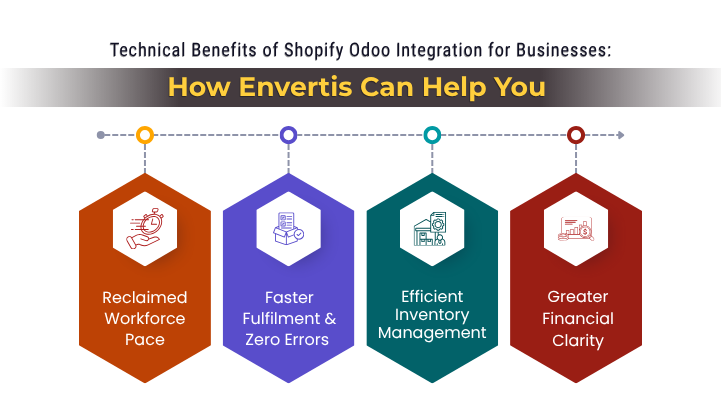
- Reclaimed Workforce Pace
Teams that were spending hours each week on manual data entry, stock reconciliation, or order chasing get that time back, and redirect it toward work that actually grows the business. For most operations, the reduction in administrative overhead is visible within the first month post-launch.
- Faster Fulfilment & Zero Errors
An automated order workflow means orders move from placement to dispatch faster, with fewer human touchpoints, reducing opportunities for mistakes. In a market where delivery speed and accuracy are genuine competitive differentiators, operational improvements translate directly into better customer experience.
- Efficient Inventory Management
With accurate, real-time stock data informing purchasing decisions, businesses stop buying defensively to cover for unreliable numbers, resulting in fewer stockouts. Less capital tied up in overstock. Better sell-through rates across the catalogue.
- Greater Financial Clarity
When every Shopify transaction flows cleanly into Odoo’s accounting module, the P&L is always up to date, GST obligations are always accurate, and cash flow visibility improves materially. For Australian businesses navigating BAS cycles and AUD fluctuations, this operational clarity has direct commercial value.
Why businesses need Shopify Odoo integration ultimately comes down to a straightforward truth: growth should make your business stronger, not harder to run. Envertis provides the right integration, which is the mechanism that makes that possible.
As a tech lead, ensure your initial scope decision is documented as a formal boundary: what is in scope, what is out of scope, and the reintegration path for out-of-scope items added later.

The Best Way to Connect Shopify and Odoo ERP: How to Get Started
Knowing how to integrate Shopify with Odoo ERP effectively is less about technical steps and more about sequencing the right decisions in the right order.
Here is a high-level overview of how a well-structured implementation typically unfolds:
- Step 1
Audit Your Business Setup
Before anything else, review your existing Shopify configuration, your Odoo instance (or evaluate Odoo if you’re implementing it fresh), and the data quality across both systems. Surface any SKU inconsistencies, customer record duplicates, or tax configuration gaps now, before they become integration problems.
- Step 2
Define Your Sync Requirements
Document precisely what needs to sync, in which direction, how frequently, and under what conditions. Prioritise by business impact: inventory and orders first, then customers and financials, then reporting and analytics.
- Step 3
Choose the Right Integration Strategy
Depending on your technical environment and scale, the right approach may be a pre-built connector, a custom API integration, or a middleware platform. Each has trade-offs in flexibility, ongoing maintenance, and upfront investment.
- Step 4
Go Live with Active Support
A phased go-live with close monitoring in the first weeks is standard practice for a reason. Having your integration partner actively engaged during this period significantly reduces the risk and duration of any early-stage issues.
For businesses pursuing Odoo integration in Australia, working with a local partner brings a specific advantage: they understand the market context. Envertis delivers end-to-end Odoo-Shopify Integration with local knowledge built in from day one.
Searching for an Honest Assessment of ERP Integration for Your Business — We’re Here!
A well-executed Odoo integration in Australia with Shopify doesn’t just fix those problems. It reorganises how your business operates, replacing manual dependency with automation. The businesses that get the most from this integration are those that approach it with the right partner and the right level of care during setup. Because an integration built properly from the start compounds in value as your business grows.
Envertis specialises in helping Australian businesses integrate Shopify with Odoo the right way. We integrate an ERP for your specific operation and provide support beyond go-live from a team that understands both the technology and the competitive marketplace in which you operate.

Frequently Asked Questions
- What data can be synced between Shopify and Odoo?
A properly configured Shopify Odoo sync can cover products and variants, stock levels, customer records, sales orders, payments, refunds, shipping details, tax data, and pricing. The exact scope of Odoo integration with a Shopify store depends on your business requirements and the integration approach you use.
- Is Shopify Odoo integration suitable for small businesses in Australia?
Absolutely, and it’s often growing businesses that benefit most immediately. Shopify inventory integration Odoo for inventory and orders eliminates the manual reconciliation that consumes disproportionate time at lower headcounts.
- How long does it take to integrate Shopify with Odoo ERP?
Timelines vary based on complexity, data quality, and the number of custom requirements involved. A focused implementation covering core order and inventory sync can typically be completed in 4-8 weeks.
- Does Shopify Odoo integration support multiple warehouses or locations?
Yes. Odoo’s inventory module is purpose-built for multi-location management, and a well-architected Odoo integration with a Shopify store can fully reflect that complexity, routing orders to the correct fulfilment location.
