
If you’re reading this, your business has probably reached the same stage.
Previously helpful spreadsheets have become a source of confusion. Your accounting solutions cannot recognise your stock levels. Your sales team uses software that is completely different from the warehouse’s. At the end of each month, closing books takes days instead of hours.
You are definitely not alone.
Each year, thousands of Australian businesses reach this stage in their development and are forced to compare three solutions: Odoo, MYOB Advanced (the new name for MYOB Acumatica), and NetSuite.
In this blog, we discuss how to determine which product to acquire among Odoo, MYOB Advanced, and NetSuite.
When Cloud ERP Software Australia Isn’t Sufficient for Your Business
There are 5 prominent telltale signs that your present system is costing you more than you think:
- Sign 1
Several spreadsheets are managed concurrently with the ERP. The ERP fails to work if the team you employ has developed Excel workarounds for issues it can’t address. Such Excel sheets hide operational pitfalls, manual data-entry flaws, version-control issues, and a lack of an audit trail.
- Sign 2
For a single feature, you are paying for an Enterprise subscription. You’re paying for things you won’t normally use if you need something exclusive to a higher tier, and everything else in that tier has no bearing on the business you own.
- Sign 3
Your procedure falls apart from the norm. Off-the-shelf ERPs manage the 80th percentile for custom commission structures, multi-tier pricing, perishable inventory by expiry date, and approval procedures with conditional routeing. The platform undermines your process rather than aids it if your brand is in the other 20%.
- Sign 4
The integration challenge. Your ERP must connect with your e-commerce platform, fulfilment provider, CRM, and a 2008 legacy system; however, the API is either nonexistent, malfunctioning, or requires a $30,000 integration project to function.
Why ERP Comparison Matters for Your Business in 2026?
The ERP software comparison in Australia has changed significantly over the past few years. Cloud ERP software in Australia is no longer a luxury reserved for enterprises with seven-figure IT budgets. Modern platforms have brought enterprise-grade capability within reach of businesses turning over as little as $2 million a year.
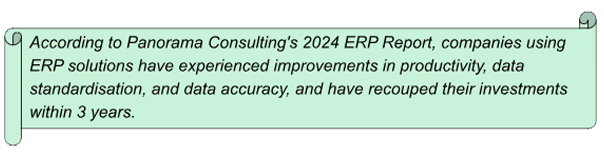
Likewise, the expenses associated with deteriorating systems are rising. Manual data input, duplicate records, and delayed reporting significantly hinder productivity. So the question is rarely whether to move to an integrated system. The real question is which one. Let us know more about the three contenders.
Core ERP Capabilities that You Should Know Before Choosing the Best ERP Software Australia
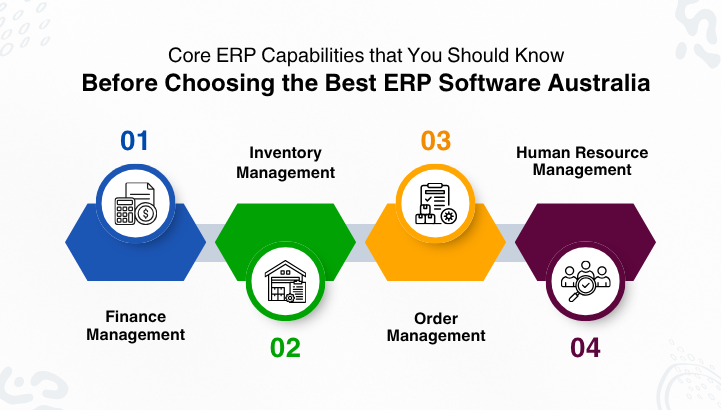
The following are the core capabilities that the best ERP for growing businesses in Australia is built around:
- Finance Management
Monthly cycles can be reduced to just three using real-time accounting. Multi-entity consolidation, automatic reconciliation, and smooth interaction with accounting software and other tools, such as inventory and CRM systems, are all supported.
- Inventory Management
Inventory variance is lowered from 18% to 3% with real-time visibility. ERP systems maintain inventory across several sites, automate reordering, and give lot and serial number traceability.
- Order Management
Order processing can be reduced from 2.5 days to 0.5 days by simplifying the order-to-cash process. ERP software’s customer relationship management features increase the accuracy and interaction of customer data.
- Human Resource Management
Payroll, tracking, and employee data through centralised HR resources, enhancing your ability to handle important company operations.
All of the above core capabilities of Cloud ERP software Australia simplify operations and improve business performance by combining accounting, inventory, HR, and CRM into a single platform.
Odoo, MYOB Advanced, NetSuite – Three ERP Platforms At a Glance
- Odoo ERP:
Odoo ERP is an open-source ERP system used worldwide, with over 12 million users. The basic framework of Odoo ERP is module-based. The Odoo modules you must use include Manufacturing, Accounting, Customer Relationship Management, and Inventory.
Later, you can download additional modules as needed. All these modules have one system, one interface, and one license. Odoo ERP software in Australia is available through certified partners who provide local settings such as GST, BAS reporting, and payroll compliance.
- MYOB Advanced (MYOB Acumatica) ERP:
It is MYOB’s cloud ERP offering for Australian and New Zealand businesses, built on the global Acumatica platform. It sits above MYOB’s small business accounting products and targets companies that have outgrown AccountRight or Xero.
It is sold in editions (Standard, Plus, Premium) with per-user licensing and is delivered through MYOB’s local partner network.
- NetSuite ERP:
Oracle, a major IT company, developed this enterprise resource planning software. This ERP software is appropriate not only for companies operating in a single country or currency, but also for those with multiple offices in various countries worldwide.
All three ERP systems above are proven platforms. The differences emerge when you look at cost, flexibility, and fit.
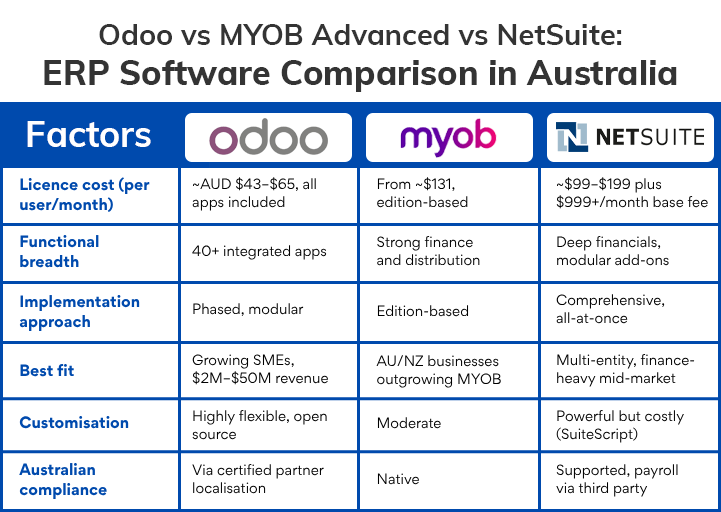
Odoo vs MYOB Advanced vs NetSuite: ERP Software Comparison in Australia
Which is the Best ERP Software Australia and Right for Your Business?
There is no universal winner, and any consultant who claims otherwise is selling rather than advising. Based on hundreds of ERP evaluations across Australian SMEs, the pattern is consistent.
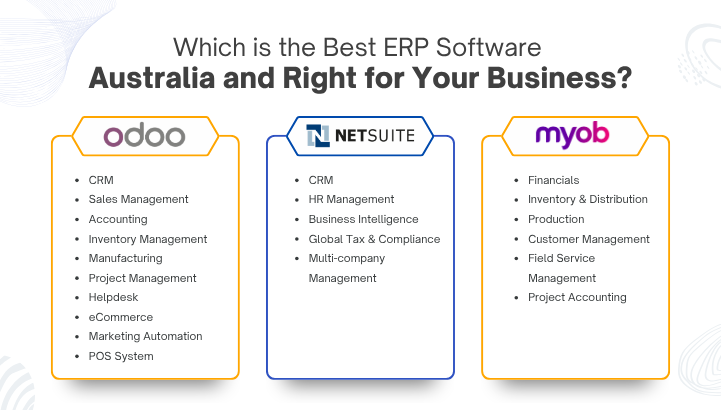
Odoo is suitable:
If your business is growing and generates $2 million to $50 million in revenue, and you’re facing difficulties in daily operations such as manufacturing, inventory management, eCommerce, and field services. The virtue of Odoo is that its modular pricing lets you benefit from enterprise-grade functionality without paying as much upfront.
Key features of Odoo ERP:
- CRM
- Sales Management
- Accounting
- Inventory Management
- Manufacturing
- Project Management
- Helpdesk
- eCommerce
- Marketing Automation
- POS System
NetSuite is suitable:
If you operate multiple legal entities in various countries, your company’s finance department makes ERP purchasing decisions, and you have a budget ready for the considerable initial expense of six figures. Companies with more than $50 million in annual revenue whose operations require extensive financial reporting should look into NetSuite.
Key features of NetSuite:
- CRM
- HR Management
- Business Intelligence
- Global Tax & Compliance
- Multi-company Management
MYOB Advanced is suitable:
If you are connected to the MYOB platform, have operations strictly in Australia and New Zealand, and need a simple, local payroll solution. However, when it comes to MYOB Advanced alternatives, many businesses can opt for more robust tools at a lower price.
Key features of MYOB Advanced:
- Financials
- Inventory & Distribution
- Production
- Customer Management
- Field Service Management
- Project Accounting
Bottomline
Spreadsheets are not the only thing the Best ERP for Small Business in Australia can accomplish. It lets you make better business decisions based on real-time data, reduce errors, expedite order processing, and improve inventory control. Purchasing the appropriate ERP software is one of the most important choices you can make, regardless of whether your company is a small one just beginning to grow or an established one seeking greater control.
Envertis is a certified Odoo Gold Partner with offices in Sydney, Melbourne, Brisbane, Adelaide, and Perth, serving SMEs across the manufacturing, retail, distribution, and professional services sectors. Our team is an expert at integrating Odoo ERP to meet your unique requirements without introducing additional complications or incurring high costs. We have a track record of accomplishment in a spectrum of industries and more than 20 years of combined experience.
Frequently Asked Questions
1. Which is cheaper, Odoo or NetSuite, for a small business in Australia?
Odoo is significantly cheaper for most small businesses. Odoo costs approximately AUD $43-$65 per user per month, including all modules. At the same time, NetSuite alternative Australia charges a base platform fee from around $999 per month plus $99 to $199 per user per month, with add-on modules priced separately. For a 10-user business, Odoo typically costs a fraction of what a comparable NetSuite subscription costs.
2. Is Odoo a good alternative to NetSuite in Australia?
Yes. Odoo has become the leading NetSuite alternative in Australia for SMEs and mid-market businesses with operational complexity. It delivers comparable functionality across accounting, inventory, manufacturing, and CRM at a much lower total cost of ownership, and its modular structure allows a phased, lower-risk implementation.
3. What is the difference between MYOB Advanced and MYOB Acumatica?
They are the same product. MYOB rebranded MYOB Advanced alternative as MYOB Acumatica to reflect the global Acumatica platform it is built on. The functionality, editions, and partner delivery model remain unchanged, so any comparison of MYOB Advanced applies equally to MYOB Acumatica.
4. Can Odoo handle Australian GST, BAS, and payroll compliance?
Yes. Odoo supports Australian GST at 10 per cent, Business Activity Statement reporting, and Single Touch Payroll Phase 2 through its Australian localisation. A certified Odoo implementation partner in Australia configures these requirements during deployment, along with local bank feeds and chart of accounts.
5. How long does an Odoo implementation take compared to NetSuite?
A phased Odoo implementation can go live with core modules in eight to twelve weeks, with additional modules added in later stages by an Odoo implementation partner in Australia. NetSuite projects follow a more comprehensive, all-at-once approach and often run for six months or longer, particularly when integrations and legacy data migration are involved.
6. What size business is Odoo best suited for?
Odoo ERP software in Australia is best suited to growing businesses with annual revenue between $2 million and $50 million, particularly in manufacturing, retail, distribution, and professional services. Its modular pricing lets smaller businesses start lean, while its scalability supports companies as they add users, warehouses, and sales channels.
7. Is NetSuite ever the better choice over Odoo?
Yes, in specific scenarios. NetSuite is the stronger option for finance-heavy organisations with multiple legal entities, international subsidiaries, and complex consolidation or revenue recognition requirements. Businesses with revenue above $50 million that have these needs should seriously evaluate NetSuite alongside Odoo.
8. What are the hidden costs of ERP implementation in Australia?
Budget solutions, data migration, integrations, training, and continuing support in conjunction with a license. For NetSuite, add-on modules and additional subsidiaries increase subscription costs over time. An Odoo partner in Australia will provide a transparent, itemised proposal covering all of these elements before you commit.
9. Do I need an Odoo partner, or can I implement Odoo myself?
Technically capable teams can implement Odoo Community themselves, but most businesses achieve far better outcomes with a certified Odoo partner in Australia. A partner handles Australian compliance configuration, data migration, process design, and training, thereby reducing project risk and considerably shortening time to value.
