
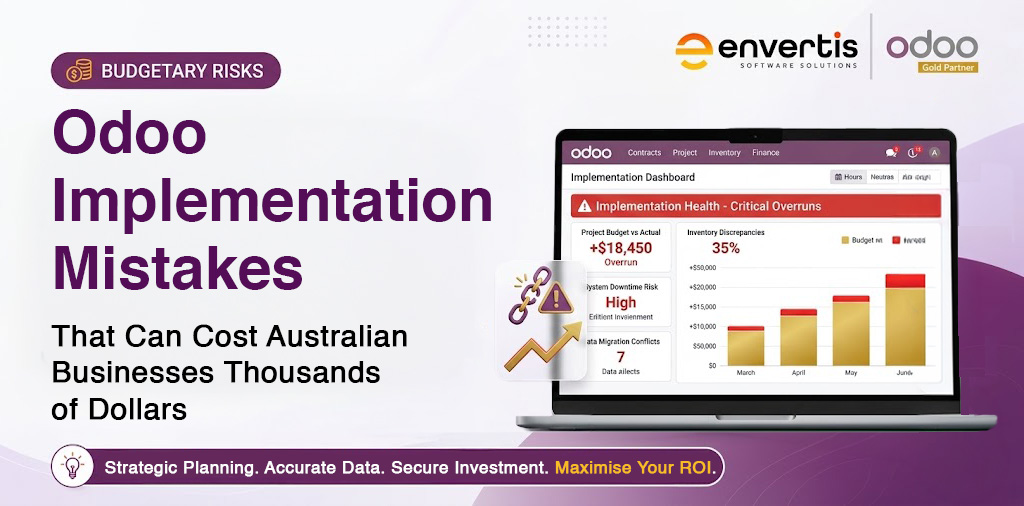
Most Odoo projects that blow the budget do not fail because of the software. They fail because of decisions made in the first few weeks, long before anyone logs in.
If you are planning an Odoo implementation Australia wide, or you are already partway through one, the gap between a clean rollout and an expensive mess usually comes down to a handful of avoidable errors.
I have watched those errors cost real money. A rushed data migration here, an over-eager customisation there, and a project quoted at one figure has quietly doubled by go-live.
The numbers back this up.
That is not a software problem. It is an execution problem.
This guide walks through the most common Odoo implementation mistakes, why they drain time and cash, and what a good team does instead.
Why Odoo Implementation Australia Trips Up Good Businesses
Odoo is a genuinely capable ERP software Odoo platform. It can run sales, inventory, accounting, manufacturing and more from a single system. That flexibility is also the trap. Because you can configure almost anything, it is easy to configure the wrong things.
Local factors raise the stakes. Australian businesses have to get GST, Business Activity Statements (BAS) and Single Touch Payroll (STP) right from day one. Miss those, and you are not just frustrated; you are non-compliant.
Cost overruns are common across the whole ERP market.
Read that again. On average, those projects cost more than three times the original estimate.
The reassuring part is that these Odoo implementation challenges are predictable. Predictable means preventable.
Here is a quick map of what goes wrong and what it costs you.
| Common Mistake | What It Costs You |
|---|---|
| No clear scope | Rework, scope creep and a blown budget |
| Wrong partner | A system that does not match how you actually work |
| Over-customisation | Upgrades that become too expensive to run |
| Poor data migration | Broken reports and a team that stops trusting the system |
| Ignoring local compliance | GST and payroll errors, and ATO headaches |
| Weak training | Low adoption and staff working around the system |
| No go-live support | Small issues that snowball into big ones |
The Odoo Implementation Mistakes to Avoid
- Starting Without a Clear Scope
Many teams buy Odoo, get excited, and start switching on modules before anyone has written down what success looks like. Scope drifts. Departments disagree on what “done” means. Budget burns on rework before a single workflow goes live.
Before you switch on any app, you want a documented plan: your goals, which modules and departments belong in phase one, a realistic timeline, and a named owner for every decision.
- Choosing the Wrong Odoo Partner
This is the single most expensive decision in the entire project. Not all Odoo service providers are equal, and certification alone does not tell you much. Many Odoo partners can make the software work technically while missing how your business runs day to day.
Fixing a misaligned setup after go-live means rebuilding workflows, re-migrating records and retraining staff who have already lost faith in the system. That is money spent twice.
Watch for these red flags when you assess Odoo service providers:
- Vague answers about method, testing and go-live criteria
- No fixed scope or change-control process
- Little real experience in your industry
- No references from projects of similar complexity
- A developer-heavy team with no finance or operations expertise
The right Odoo implementation partner Australia businesses need brings functional, finance and project people to the table, not just coders. That balance is what keeps a rollout aligned with how you earn revenue.
- Over-Customising Too Early
Odoo gives you tons of freedom since it is open source. That is also the trap. Teams often jump straight to custom code instead of fitting their process to Odoo’s out-of-the-box features.
The further you go down that road, the more your system drifts from the core, and eventually upgrading becomes a nightmare. Gartner points out that heavily customised ERPs often fail to keep up with business changes and end up much pricier to maintain or replace later.
Experienced teams follow a simple rule: configure first, customise second, and build custom code only when there is a real business reason.
- Underestimating Data Migration
Most people think data migration will be easy, but it is almost always messier than expected, and the fallout can be brutal. Legacy systems are a minefield of duplicates, missing info, and outdated records. Push that mess into a new platform, and your reports are wrong from day one.
When people see numbers do not match, they start losing faith in the system and sneak back to their familiar spreadsheets. That is how expensive Odoo ERP software projects turn into shelfware.
A skilled Odoo implementation team cleans up the data before migrating, tests everything in a staging environment, and ensures every department signs off before going live to avoid disaster.
- Ignoring Australian Compliance and Localisation
This is where generic advice falls short, and where local knowledge earns its keep. A rollout that ignores Australian rules costs you later.
Your Odoo ERP implementation Australia setup needs to handle GST correctly, produce clean BAS, and run STP reporting to the ATO. Getting this wrong creates compliance risk, possible penalties, and hours of manual correction every reporting period.
This is one reason a locally aware Odoo implementation partner Australia businesses can rely on matters. Compliance is not an afterthought you bolt on at the end. It belongs in the design from the start.
- Skimping on Training and Change Management
You can set up the perfect system, but if people do not use it, none of that matters. Resistance to change is one of the biggest Odoo implementation challenges, and it is almost always underfunded.
People need to see why the change matters and how it improves their work. Do not just toss them a PowerPoint and call it training. Give them hands-on experience, show them what their daily tasks will look like, and let them try things out.
- Treating Go-Live as the Finish Line
Going live is not the end; it is where the real challenges show up.
The first month after launch gets messy, because real-life transactions find problems testing never caught. So set aside time and resources for strong post-launch support, often called “hypercare.” This is when you jump on issues fast and help everyone settle in. If you skip this, small hiccups can snowball into much bigger headaches.

Recognise your project in any of these?
A quick chat can help you course-correct.Counting the Real Odoo Implementation Costs
It is tempting to judge a quote by the licence fee alone. That is a mistake. The true Odoo implementation cost Australia businesses face includes configuration, data migration, integrations, training and ongoing support.
Underestimating those items is how budgets blow out. A cheaper quote that skips proper testing or training almost always costs more once the rework starts. When you compare Odoo implementation services, compare what is actually included, not just the headline number.
Getting it right pays off.
Experience is not an added cost. It is what protects the budget.
Odoo Implementation Best Practices: A Quick Checklist
Every successful Odoo implementation Australia wide starts with the same habits.
Hold every provider to these Odoo implementation best practices before you begin:
- Write a documented scope with clear phase-one boundaries
- Choose your partner on experience and references, not price alone
- Map your processes before configuring anything
- Clean and test your data before migration
- Build in GST, BAS and Single Touch Payroll from the start
- Invest in role-based training and internal champions
- Plan a support window for the weeks after go-live
Print it, stick it on the wall, and measure every quote against it. These are the Odoo implementation mistakes to avoid, turned into a plan you can actually follow.
Choosing Odoo Partners Who Protect Your Budget
Dodging common pitfalls in Odoo ERP implementation is not about luck. It is about a solid process, local experience, and the right partner who has done this before.
That is where Envertis steps in. As a certified Odoo Gold Partner with teams in Sydney, Melbourne, Brisbane, Adelaide, and Perth, we have handled over 80 Odoo implementations since 2017. Odoo recognised us as an Odoo Centre of Excellence in 2018.
The Envertis crew combines sharp technical know-how with hands-on experience in finance and operations, handling everything from CRM and accounting to full-scale, multi-module systems.
Whether you are planning a fresh Odoo implementation Australia wide, comparing Odoo CRM providers, or rescuing a project that has drifted off course, a short conversation can save you thousands.
Lock in a fixed Odoo scope before spending anything.
Book your free consultation.Frequently Asked Questions
Q. What percentage of ERP implementations fail?
Gartner research from 2024 predicts that by 2027, more than 70 per cent of recently implemented ERP initiatives will fail to fully meet their original goals, with up to 25 per cent failing badly. In most cases, the cause is poor planning or the wrong partner, not the software itself.
Q. How much does an Odoo implementation cost in Australia?
It depends on your size, the number of modules and how much customisation you need. The honest answer is that the Odoo implementation cost Australia businesses pay is driven far more by scope and data quality than by licence fees. Ask for a fixed, documented scope so there are no surprises later.
Q. How long does an Odoo implementation take?
Anywhere from a few months to a year or more, depending on complexity. A focused, phased rollout of core modules is usually faster and safer than switching everything on at once.
Q. How do I choose the right Odoo partner?
Look past certification. Ask about their method, testing process, data migration approach and post-go-live support. Strong Odoo partners give clear answers and real references. Vague, sales-heavy responses are a red flag.
Q. Can Odoo handle Australian GST and Single Touch Payroll?
Yes, when it is set up correctly. This is exactly why local knowledge matters. A team familiar with Australian compliance will configure GST, BAS and Single Touch Payroll properly from the start, so reporting to the ATO stays clean.
Q. What is the most expensive Odoo implementation mistake?
Usually a combination of over-customisation and poor data migration. Both create hidden problems that only surface after go-live, when they are far harder and costlier to fix.
