
Blogs
Discover how Odoo ERP helps Australian SMEs reduce NetSuite licensing and running costs with a transparent TCO comparison and practical migration plan.
The CFO opens their inbox and sees another NetSuite renewal notice. The price has jumped again, and no one really knows what they are paying extra for.
If that sounds like your situation, you are definitely not alone. Plenty of Australian businesses are starting to look at alternatives, and Odoo ERP keeps coming up as a way to get the same results for a lot less.
For most small and medium businesses, Odoo actually ticks the boxes. It handles finance, inventory, sales, purchasing, manufacturing, CRM, and payroll. Pricing is upfront, per user, and you choose where to host it.
Below, we break down where the savings come from, where NetSuite still makes sense, and how to switch without disruption.
Here is what a senior implementation consultant would tell you across the table.
NetSuite is a capable platform. It suits large, multi-entity groups with complex global consolidation. For most Australian SMEs, the problem is not the software. It is the cost structure wrapped around it.
NetSuite pricing is quote-based and not published. A typical subscription is built in layers, and most of those layers renew every year:
Base platform licence: the annual fee for core financials and access to the platform
Named user licences: a paid seat for each person who logs in, priced by access level
Add-on modules: advanced financials, inventory, manufacturing and planning, each licensed separately
Implementation and customisation: partner fees for setup, scripting and integrations
Ongoing support and development: extra costs that grow as your system grows
Hidden costs are a problem across the whole ERP market.
In Panorama Consulting's 2026 ERP Report, 30% of respondents said their ERP project ran over budget. Panorama's 2024 report found that among over-budget projects, 51% cited additional technology requirements as a cause.
That is why so many finance leaders now look for a NetSuite alternative. A quick search for NetSuite competitors Australia returns a long list, but everyone shares the same goal: reduce ERP software costs without losing capability.
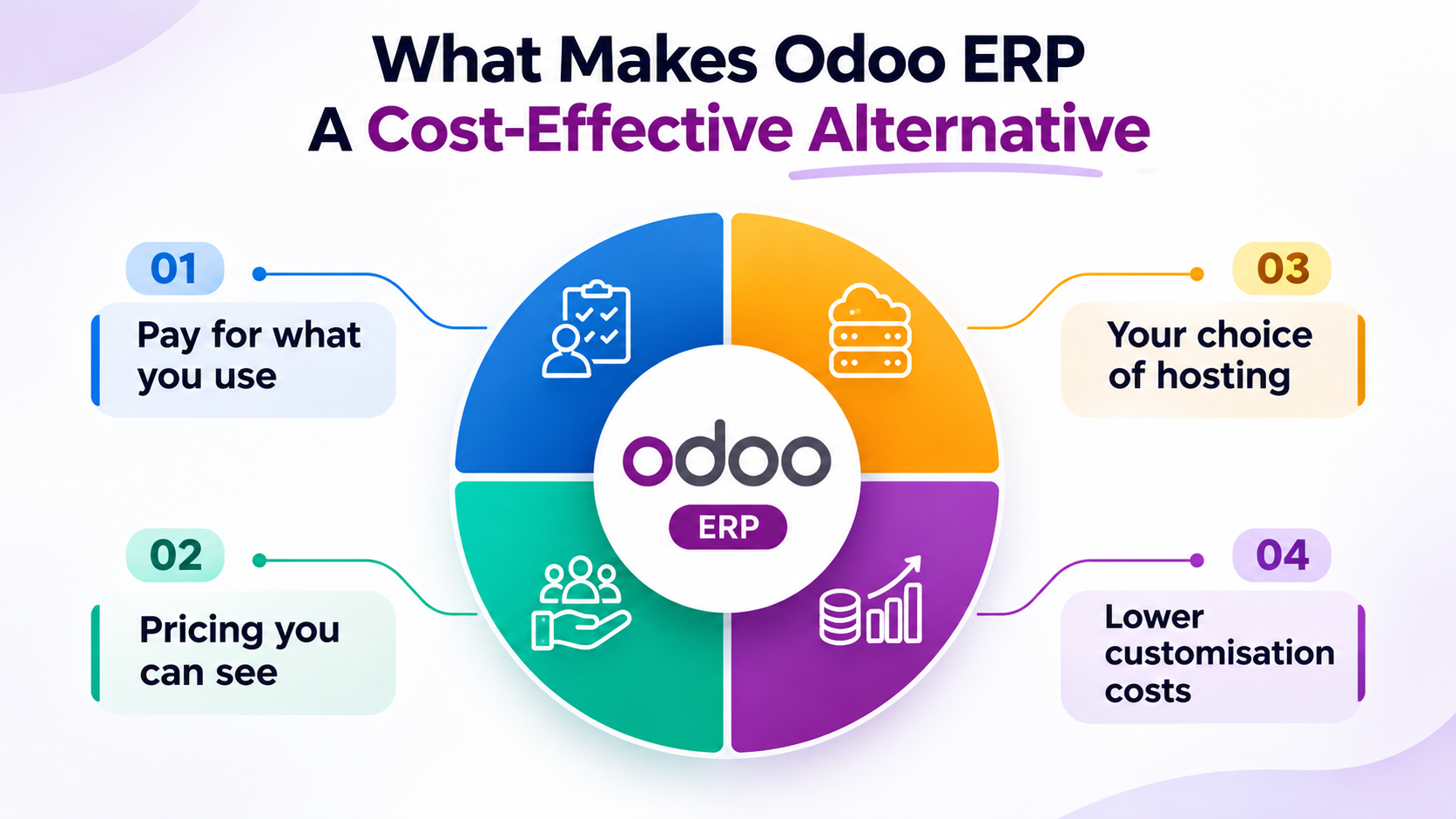
Odoo ERP software takes a different approach to cost. It is modular, built on an open-source core, and priced per user. In its paid plans, the apps are included rather than sold one by one. That makes it a strong, cost-effective ERP software option for growing businesses.
Pay for what you use
Odoo is a set of connected apps: Accounting, Inventory, Sales, Purchase, Manufacturing, CRM, eCommerce, Project, Helpdesk, Payroll and more. You start with the apps you need today. When you are ready for more, you switch on another app instead of signing a new module contract.
Pricing you can see
Odoo publishes its plans online, from a free single-app plan to its Standard and Custom plans. For current Odoo ERP pricing Australia, check the per-user rates in AUD on odoo.com/pricing. Because prices are public, your CFO can model costs before the first sales meeting.
Your choice of hosting
You can run Odoo on Odoo Online (software as a service), Odoo.sh (managed cloud) or your own servers. Your IT team stays in control instead of being tied to one vendor's cloud.
Lower customisation costs
Odoo is built on Python and an open framework, backed by a large global developer community. Custom work is usually quicker to build and easier to maintain. You do not rely on a small pool of specialist developers.
Put simply, this is why Odoo ranks among the most practical, affordable ERP solutions for SMEs on the market.
If you want the facts at a glance, here is a fair NetSuite vs Odoo ERP comparison across the points Australian SMEs ask about most.
| Factor | Odoo | NetSuite |
|---|---|---|
| Pricing model | Per-user subscription, apps included in paid plans | Base licence plus named users plus separately licensed modules |
| Pricing transparency | Published online | Quote-based, not published |
| Adding new functions | Switch on another app | Usually a new module licence |
| Hosting options | Odoo Online, Odoo.sh or on-premise | Oracle-hosted cloud only |
| Customisation | Open Python framework, large developer community | SuiteScript, specialist developers |
| Australian localisation | GST, BAS reporting, AUD, ABA bank files, local payroll | Australian tax localisation available; check payroll scope |
| Vendor lock-in risk | Lower: open-source core and choice of host | Higher: proprietary platform and annual renewals |
| Scalability | Add users and apps as you grow | Scales well, but cost rises with each user and module |
| Best fit | SMEs and mid-market firms wanting control and predictable costs | Large multi-entity groups with complex global needs |
The Odoo vs NetSuite decision is rarely about features alone. Both systems can run a growing business. The real difference shows up on the invoice, year after year.

Want this comparison built on your own numbers?
Talk to our experts.Licence fees are only the starting point. A fair Odoo ERP vs NetSuite pricing review looks at total cost of ownership (TCO) over three to five years.
TCO adds up everything you pay to own and run the system:
1. Software licences and subscriptions
2. Implementation and data migration
3. Customisation and integrations
4. Training for your team
5. Ongoing support and version upgrades
An illustrative scenario
Picture a fictional Sydney wholesale distributor with 25 users. This is an illustration, not a client result.
| Cost Area | On NetSuite | On Odoo |
|---|---|---|
| Licences | Base platform fee, 25 named seats, plus inventory and finance modules, renewed each year | 25 users on one plan, apps included |
| New capability | Each new module adds a licence line | Usually no new licence; configure another app |
| Customisation | Specialist SuiteScript work | Python work, wider talent pool |
| Third-party tools | Paid connectors are common | Built-in apps replace many separate tools |
| Upgrades | Delivered by the vendor; custom scripts need testing | Annual versions; upgrades planned with your partner |
In this scenario, the biggest saving does not come from one line. It comes from paying for one platform instead of a growing stack of licences. That is the core of the Odoo ERP cost advantage.
When you weigh Odoo implementation cost vs NetSuite, compare the full project, not just the first-year quote. Ask each provider to price data migration, training and post-launch support in writing.
Software spend is only half the story. The bigger savings often sit in how your team works every day.
As ERP software to reduce operational costs, Odoo targets the manual work that quietly drains hours:
Automated routine tasks: reorder rules, invoice matching and approval workflows run without chasing
One database: sales, stock, purchasing and finance share the same live data
Fewer subscriptions: built-in CRM, helpdesk, eCommerce, email marketing and e-signature can replace separate tools
Real-time visibility: live dashboards for stock, margins and cash flow
Faster month-end close: bank feeds and automated reconciliation cut days of manual checking
Less double entry: an order entered once flows through to delivery, invoice and ledger
For Odoo ERP for small and medium businesses, this means a lean team can handle more volume without hiring ahead of growth.
When you use Odoo Australia localisation, your system is ready for local rules right from the start:
GST and BAS: Australian tax codes and BAS reporting are already in the Accounting module.
Australian chart of accounts: Your accountant will instantly recognise the familiar structure.
AUD and multi-currency: Easily manage business with overseas suppliers and customers in one place.
ABA bank files: Pay suppliers and staff using the standard files Australian banks accept.
Payroll: Odoo’s payroll setup covers Single Touch Payroll Phase 2 and SuperStream compliance.
Odoo recommends double-checking that payroll matches your needs before you go live. Honestly, that is smart advice. This is exactly where local Odoo ERP software experts prove their value.
Run through this quick checklist. Each point is a sign that Odoo deserves a closer look:
1. Your NetSuite renewal keeps rising, and you cannot see matching value.
2. You pay for seats or modules that few people use.
3.Your team still relies on spreadsheets or add-on tools to fill gaps.
4. You want to own your data and choose where it is hosted.
5. You plan to add users, sites or product lines, and you want costs that scale fairly.
6. You need changes made quickly, without long developer queues.
If you ticked three or more, Odoo as an alternative to NetSuite is worth a serious conversation. This is especially true for Odoo ERP for small and medium businesses in manufacturing, distribution, retail and eCommerce.
To be fair, NetSuite may still suit you better in some cases. Think of a group running many legal entities across several countries, with complex consolidation and a mature, well-used NetSuite setup. A good adviser will tell you that plainly.
Switching ERP feels risky, but a structured plan removes most of the risk. A proven migration path has five steps:
Discovery and cost audit: review current licences, modules, workflows and pain points.
Process mapping: map how work flows today, then design how it will run in Odoo.
Data migration: clean and move customers, suppliers, products, open balances and the history you report on.
Phased go-live: launch in stages and run key reports side by side until the numbers match.
Training and support: train each team on its own workflows, then keep a support line open after launch.
Ready to Cut Your ERP Costs?
Book your free Odoo cost comparison with Envertis.For most SMEs, yes. Odoo publishes per-user pricing with apps included in its paid plans. NetSuite adds a base licence, user seats and separately licensed modules. A full Odoo ERP vs NetSuite pricing review should still cover implementation, support and upgrades over three to five years.
Your Odoo ERP cost depends on user numbers, your hosting choice and how much customisation you need. For current subscription rates, check Odoo ERP pricing Australia in AUD on odoo.com. Implementation is priced separately, based on scope, data migration and training.
Yes. Odoo's Australian localisation includes GST tax codes, BAS reporting, an Australian chart of accounts and ABA bank files. Its payroll documentation states compliance with STP Phase 2 and SuperStream. If you run complex award conditions, confirm payroll scope with your implementation partner before going live.
It depends on your modules, data volume and integrations. Many SMEs move in phases, starting with finance and inventory, then adding other areas. When you compare Odoo implementation cost vs NetSuite, include migration time, data cleansing, and parallel testing, so the plan reflects the real effort.
Yes. Odoo supports multi-company, multi-currency and multi-warehouse operations, so it grows with you. That makes Odoo an alternative to NetSuite and a practical choice for scaling firms. As ERP software to reduce operational costs, it also lets you add users and apps without a new contract each time.
You do not have to, but most SMEs benefit from one. A local Odoo Australia partner understands GST, BAS, payroll and local banking, and works in your time zone. The right partner helps you choose affordable ERP solutions for SMEs without paying for features you do not need.
Get free consultation and let us know your project idea to turn it into an amazing digital product.

Se 506, 8 Help Street, Chatswood, NSW 2067
324 Queen Street, Brisbane, QLD 4000
171 Collins Street, Melbourne, VIC 3000
