

If you are a Project Manager, Operations Head, or Finance Lead at a consulting, IT services, engineering, legal, or staffing firm, you have almost certainly felt this.
Projects overrun without early warning. Invoice cycles drag. Your pipeline tells you one thing while delivery tells you another.
If you are a project or business owner running a project-based or service-led firm, you have almost certainly felt this.
Odoo changes the equation. It is a unified ERP platform built around how project-based businesses actually operate.
This blog explains exactly why Odoo ERP is becoming the default choice for professional services firms that are serious about operational control.
Project-centric Challenges in Professional Services
The core tension in professional services is this: your revenue is delivered through people, structured as projects, and billed by the hour. That model creates specific operational demands that most ERP platforms, built with product companies in mind, handle poorly.
The pain points are consistent across firms of different sizes and sectors.
Stockpiled tools
Project data sits in one system, finance in another, HR in a third. No one has a single view of where the business stands, so decisions are made on incomplete information.
Manual timesheets
When consultants log time days after the fact, or not at all, the downstream impact hits billing accuracy, project cost visibility, and ultimately margin.
Billing delays
Finance teams are waiting on delivery teams to close tasks before they can invoice. That lag compounds across a portfolio of active projects, creating entirely avoidable cash flow problems.
Poor project visibility
Without real-time data across tasks, resources, and costs, project managers are always working from last week’s picture. By the time a problem surfaces in a report, the window to correct it has often closed.
These are not technology problems. They are structural problems that emerge when the tools running the business were never designed to work together.
The fix, therefore, is not a better spreadsheet or a tighter process. It is not a workaround or a middleware layer that stitches disconnected systems together. It is a platform built from the ground up around how service businesses actually operate, where the project is the unit of delivery, the person is the unit of capacity, and the invoice is the endpoint of a chain that starts the moment work begins.
That is the structural difference Odoo brings. This is not merely Goods ERP transformed into a Services ERP; rather it’s an inherently modular, natively integrated Platform, purpose-built to support the entire Project Lifecycle, from Scope & Resource Planning all the way through Delivery, Timesheet processing, and Billing in a single location with a single dataset that need not be reconciled across disparate applications that were never designed to work together.
What makes Odoo ERP Software a Good Fit for project-based firms?
Most ERP platforms were built for the wrong business model. Professional services firms, which sell expertise delivered through people and bill against time and outcomes, have been forcing those platforms to fit an operating model they were not designed for.
Odoo ERP software takes a different approach. Its modular architecture means the platform is not a monolith. You deploy what your business needs, and every module is built to work natively with every other.

Here are the key benefits Odoo ERP software brings to project-based professional services firms:
- Purpose-built for services
You have spent years forcing a product-centric ERP to fit a business that sells expertise, not units, and the workarounds have cost you more than the software ever saved. Odoo ERP software is built from the ground up for firms that bill by time and outcomes, so the platform reflects how your business actually generates revenue, not how a manufacturer does.
- Modular, flexible deployment
Most ERP platforms make you pay for and manage a system full of modules your business will never use. With Odoo, you deploy only what your operation requires, keeping the system lean, focused, and aligned to your actual workflows without the bloat of a one-size-fits-all implementation.
- Native module integration
When your project management tool and accounting platform are different systems, someone is always manually bridging the gap, and that gap is where billing errors, delays, and revenue leaks live. In Odoo, project delivery and financial management operate natively within the same system, with no third-party integrations to maintain or break.
- Real-time capacity planning
The moment you commit a team member to a new engagement without knowing their current workload, you create either a delivery risk or a revenue gap. Odoo updates resource allocation instantly when assignments change, giving operations and delivery leads an accurate picture of who is available, at what capacity, and across which projects, before problems are locked in.
- Live, unified dashboards
If your Monday morning numbers depend on someone spending Friday afternoon pulling reports from three different systems, your decisions are always based on last week’s reality. Odoo replaces that manual reconciliation process with real-time dashboards that give leadership a single, current view of project performance, utilisation, and financial position, without the wait.
- A fundamentally different operating model
Fragmented tools do not just slow your team down; they structurally limit how well your business can be managed, because no one ever has the full picture at the right time. Moving to Odoo is not an upgrade to what you already have. It is a shift to an operating model in which delivery, finance, and resources are driven by a single source of truth, and where that visibility changes what your leadership team can actually do.
For firms that have spent years managing these functions across disconnected tools, this is not an incremental improvement. It is a different way of operating.
The shift to a unified Odoo ERP platform means decision-makers can see actual project margins, finance teams can close billing cycles faster, and project managers can surface resourcing conflicts before they escalate.
Key Odoo Modules That Drive Project Success
The strength of Odoo for professional services lies not in any single module, but in how the core modules interact. Here is what that looks like in practice:
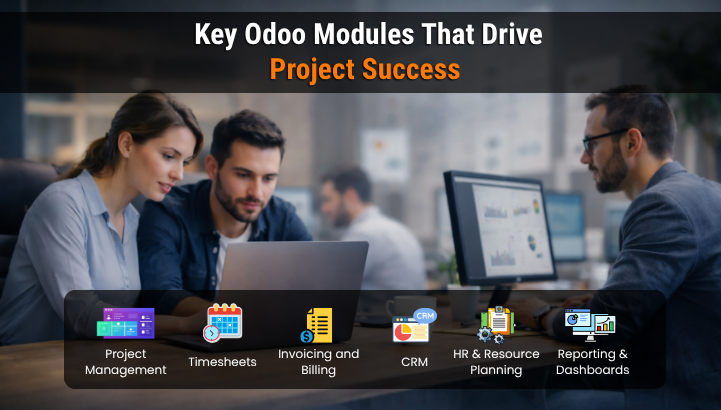
Project Management
You cannot fix a project that is already off track — you can only manage the fallout. When delivery data lives separately from financial data, project managers are always working from a delayed picture, and by the time a budget overrun surfaces in a report, the window to correct it has closed. Odoo’s project module connects task management, milestone tracking, Gantt views, and Kanban boards directly to client contracts and financial data. Progress against scope and budget consumption is visible in real time — in the same system, without switching tools.
Timesheets
Billable hours not captured are billable hours not invoiced. When consultants log time days after the fact, or inconsistently across disconnected tools, the downstream damage hits billing accuracy, project cost visibility, and ultimately margin. In Odoo, billable staff log time directly against live tasks and projects. The data is automatically sent directly to our billing system and is not subject to a manual export, reconciliation, or delay. The approval process, with automatic reminders for late or missing timesheets, ensures that all timesheets receive timely follow-up and don’t become a problem.
Invoicing and Billing
Most billing delays are not caused by slow finance teams; they are caused by a process that was never designed to move quickly. When invoice generation depends on manual triggers, multiple handovers, and data pulled from separate systems, the lag is structural. Odoo removes that structure entirely. All four billing models (Fixed Fee, Time & Material, Milestone Based, and Retainer) operate on the same platform.
Invoices are created and sent automatically by the system when any preconfigured trigger occurs, when a task is marked complete, a milestone is approved, or a billing period ends, with no human intervention required to execute invoicing.
CRM
The gap between a deal closing and a project starting is where context gets lost, terms get misremembered, and early delivery suffers. When sales and delivery operate in different systems, someone has to manually transfer client information, agreed rates, scope boundaries, and team assignments, and something always gets dropped.
When a deal closes in Odoo, the handover to project setup is immediate. Client context, agreed terms, rate cards, scope boundaries, and assigned team carry through automatically into the project and billing modules. Nothing is re-entered. Nothing is interpreted. Nothing is lost.
HR and Resource Planning
Double-booking a senior consultant, discovering a key resource is over-committed two weeks into a new engagement, or scrambling to staff a project at the last minute, these are not edge cases. They are the predictable consequence of managing resource allocation across spreadsheets and inboxes.
Odoo’s HR module gives leadership genuine visibility into capacity, who is available, at what utilisation level, and across which active projects. For professional services firms, where people are simultaneously the product and the constraint, this is the module that prevents the operational mistakes that cost the most.
Reporting and Dashboards
If your Monday morning review depends on someone compiling data from three different systems over the weekend, you are not reviewing the business; you are reviewing last week’s version of it. Most of the time, you will be too late to react to an issue that appears in a report once it is produced and sent out.
You won’t be able to use Odoo at the same time to live create a dashboard report on project profitability, utilisation rates, billing pipeline and financial performance – you can specify your report based on project, client, team, or timeframe. Leadership will shift from reviewing past occurrences to anticipating them much sooner.
Real-world Results: What Firms Gain After Odoo Implementation
Our clients consistently report patterns that professional services firms such as Envertis commonly observe following a well-structured Odoo ERP deployment. They are illustrative; specific results depend on the quality of implementation, data hygiene, and user adoption, but they are grounded in what properly configured Odoo environments make possible.
Billing Cycle Compression
When timesheet data flows directly into billing without manual export or reconciliation, the time between work completion and invoice delivery shortens materially. Firms that previously ran two- to three-week billing cycles report moving to weekly or fortnightly cycles after implementation, a 60% to 75% reduction in time-to-invoice.
The downstream impact on cash flow is direct. A firm invoicing 00K per month that compresses its billing cycle from 21 days to 7 days recovers an average of 7,000–1,000 in working capital that was previously tied up in unbilled receivables. The Hackett Group reports that organisations with automated billing processes achieve a Days Sales Outstanding (DSO) reduction of up to 20%, a figure that translates directly into cash flow you can deploy.
Real-Time Project Margin Visibility
When project costs, resource utilisation, and revenue are visible in a single system, managers can monitor project-level profitability in real time rather than at month-end. Aberdeen Group research found that best-in-class professional services firms are 3.5× more likely to have real-time project financial visibility than their peers, and those firms report 82% on-time, on-budget project delivery, compared with 52% for firms without that visibility.
Problems that would previously surface in a retrospective review can be caught and corrected mid-project. For a typical professional services engagement with a 15% target margin, catching a 5-point margin erosion at the midpoint, rather than at closeout, can mean the difference between a recoverable and an unrecoverable outcome.
Faster Staff Onboarding
A single unified system is materially easier to onboard into than a collection of disconnected tools, each with its own login, data structure, and process. Clients report new hires becoming operational across timesheets, project tasks, and communication workflows within 3 to 5 business days, compared to an industry average of 2 to 4 weeks across fragmented toolsets.
Gallup’s research on employee onboarding found that organisations with a structured, system-supported onboarding process see 70% higher productivity in the first 12 months. When your tools and processes live in one place, that structure comes built in. For firms with high headcount growth or regular contractor cycles, the compounding value of faster onboarding is significant.
Reduced Administrative Overhead
Automating routine processes, timesheet reminders, invoice generation, project status updates, and resource scheduling notifications removes administrative burden from senior staff, redirecting that capacity toward billable and strategic work.
McKinsey estimates that up to 40% of finance and operations tasks in professional services firms are automatable with current technology. Firms that deploy Odoo ERP report recovering an average of 8 to 12 hours per week per senior staff member that were previously consumed by manual coordination, data chasing, and report compilation. At a fully loaded cost of 50/hour for a senior consultant, that equates to 200–800 in recovered billable capacity per person, per week.
For partners and senior consultants, this is often the most immediately appreciated change, and the one most directly tied to margin improvement.
More Confident Forecasting
With accurate data on pipeline, resource availability, active project status, and billing run rate all in one place, leadership teams report significantly greater confidence in revenue forecasts and capacity planning. A 2023 Panorama Consulting ERP Report found that organisations on integrated ERP platforms close their books 25% faster and are 2.1× more likely to achieve forecast accuracy within a 5% variance band.
Decisions that previously relied on gut feel or manual reconciliation are now made on a reliable data foundation. For CFOs, the practical result is a revenue forecast you can take to the board, not one you have to qualify with three pages of assumptions and caveats.
The outcomes you’re looking for will not occur just because you’ve installed the solution. They result from a well-defined implementation, strong user adoption, and an appropriately configured solution aligned with how your company operates. The platform creates the environment, and the implementation defines the outcome.

Ready to Build a Project-centric Operations on Odoo?
Professional service firms that operate with genuine control have one thing in common: they run their projects, their people, and their finances from a single source of truth. Every decision is made from current data. Every billing cycle closes on time. Every resourcing conflict surfaces before it becomes a problem.
Odoo gives you the platform to operate that way. Envertis gives you the implementation to make it happen correctly — from initial discovery through to ongoing optimisation, built around the specific way your firm works.
If your business is ready to move beyond the limitations of disconnected tools, the right starting point is a conversation about what your operation actually needs.

