
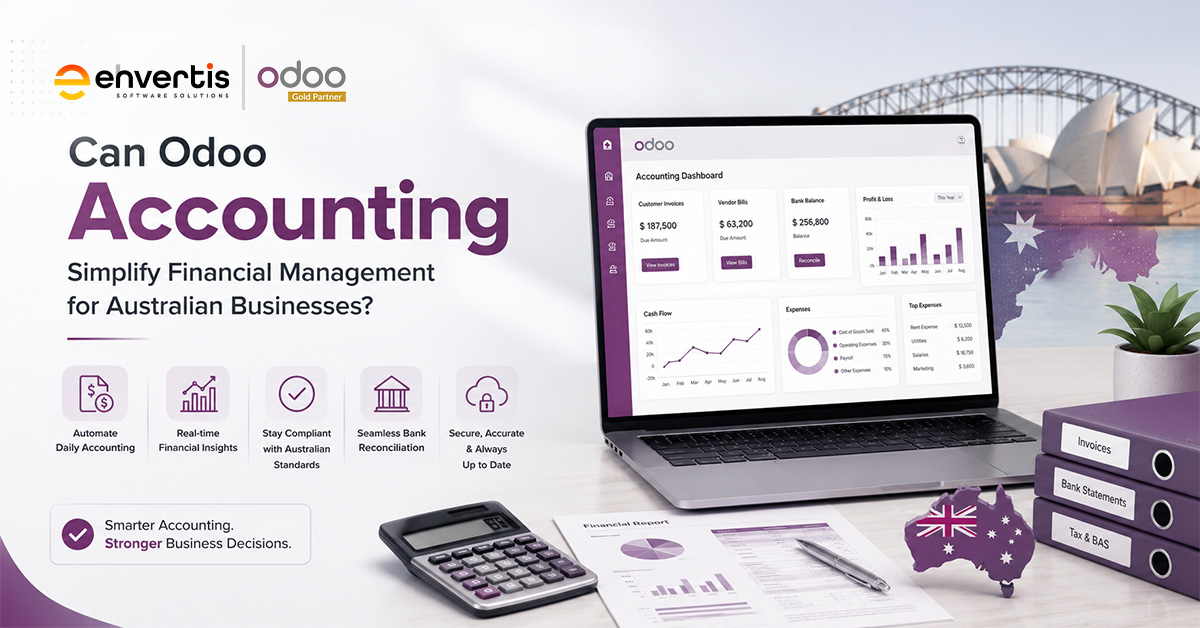
It is Tuesday afternoon, and your finance lead is still chasing three overdue invoices. The sales figures sit in one spreadsheet. Stock levels sit in another. Your BAS deadline is a week away, and nobody is certain the numbers match.
Sound familiar?
Many Australian wholesalers, distributors, and manufacturers run their finances across disconnected tools that don’t talk to each other.
The result is slow reporting, manual errors and cash that leaks out unnoticed. This is where Odoo accounting earns attention. It pulls invoicing, banking, inventory and tax into one connected system. For a growing business, that shift can mean the difference between reacting to problems and seeing them early.
In this blog, we look at whether Odoo accounting software can genuinely simplify financial management for Australian businesses, how it handles GST, and what to weigh before you commit.
The Hidden Cost You Pay for Disconnected Financial Tools
Disconnected systems do not just slow you down. They cost real money. The digital economy is transforming business operations and customer communications.
However, many Australian SMEs still rely on outdated methods, which limit growth, compromise data accuracy, and make day-to-day operations unreliable. The best accounting software in Australia solves this challenge by providing the advantages you need in one place: flexibility, simplicity, and scalability.

Cash flow pressure follows close behind. Today’s organisations expect an integrated ERP to handle finance, sales, inventory, and HR. Odoo accounting software meets this demand through a module-based approach that lets businesses digitalise one block at a time, starting with the area that delivers the highest return.
For wholesalers and distributors, the problem multiplies. Margins are thin. Stock ties up capital. A single reporting delay can hide a pricing error for weeks. This is why accounting software for Australian businesses needs to connect finance with operations, not sit beside it. A ledger that cannot see your stock or your sales gives you a rear-view mirror, not a dashboard.
How Does Odoo Accounting Software Bring Finance Into One System
Odoo GST accounting Australia is one module inside a wider business suite. That design is the point. When your sales, purchasing, inventory and accounting share the same database, a sale updates stock and the ledger at the same moment, no re-keying and no overnight sync that breaks before month-end.
Here is how Odoo accounting Australia brings finance into one system:
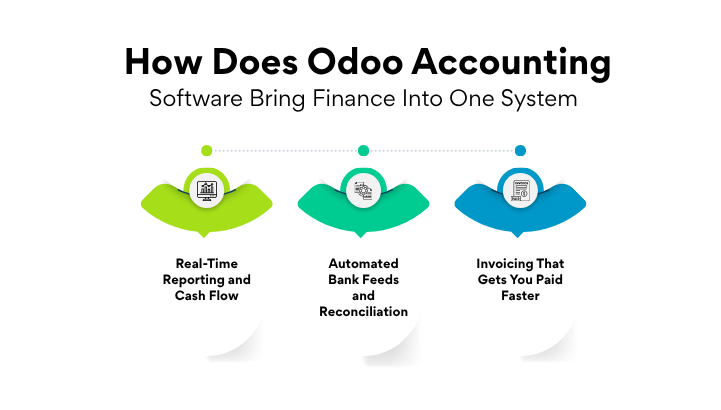
- Real-Time Reporting and Cash Flow
You see profit, expenses and outstanding invoices as they happen. Dashboards update live. You can forecast your cash position for the weeks rather than guessing from figures that are already a month old. For a distributor deciding whether to place a large stock order, accounting software for Australian businesses is the difference between a confident call and a gamble.
- Automated Bank Feeds and Reconciliation
Odoo accounting software for Australian SMEs connects to bank feeds and automatically matches transactions. What once took a sonorous day to reconcile can straightaway be done in an hour. The system spots duplicate records and suggests matches, letting staff focus on cases that genuinely require human judgment.
- Invoicing That Gets You Paid Faster
By implementing Odoo accounting software for SMEs, you can send invoices with online payment links and automatic reminders. Customers pay sooner when paying is easy. Faster payment eases the late-payment problem that costs the sector so much, without adding a single hour of chasing to your week.

How Odoo GST Accounting Australia Handles Finance Compliance
Compliance is where many owners judge an accounting system. Odoo Australian accounting supports the local essentials. It applies the 10 per cent GST the Australian Taxation Office levies on most goods and services, and it automatically tracks GST on both sales and purchases. Nothing gets missed because a line item was entered by hand.
At BAS time, the system compiles the figures you need rather than making you rebuild them from scratch. Most Australian SMEs lodge quarterly, and Odoo ERP accounting Australia keeps the running totals ready. It also supports both cash and accruals reporting, which matters because your reporting basis affects cash flow and timing.

For exporters, accounting software for Australian businesses handles multi-currency transactions and zero-rated export sales. Garment makers and food producers selling into Europe or Asia keep clean records without a separate workaround. This is where Odoo GST accounting Australia moves from a compliance checkbox to a genuine time saver, and where Odoo ERP accounting Australia starts to pay for itself.
What Odoo Accounting Delivers for Manufacturers and Distributors
Wholesale, distribution and manufacturing businesses have needs that generic bookkeeping tools ignore. Odoo accounting for distribution companies and Odoo accounting software for SMEs or small manufacturers connect the ledger to the warehouse floor.
Here is what that looks like in practice:
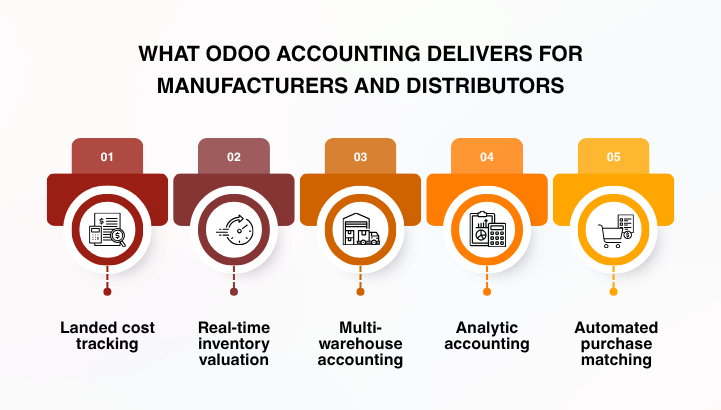
- Landed cost tracking: All transportation expenses, including freight, taxes, and handling fees, are included in production costs. Thus, profits are truly reflected.
- Real-time inventory valuation: Inventory value is updated automatically based on either FIFO or average cost methods.
- Multi-warehouse accounting: Each warehouse location operates separately but produces summarised accounts at the end of the accounting period.
- Analytic accounting: It tags revenues and costs by production line or consumer.
- Automated purchase matching: The order, receipt, and invoice matching helps minimise the chance of invoice-related discrepancies.
Each feature closes a gap where revenue quietly slips away. Together, they turn Odoo business accounting solutions into a control system, not just a record of what already happened.

How to Use or Implement Odoo Accounting Features and Benefits
Managing your finances doesn’t have to be complicated. Odoo accounting gives Australian businesses one place to handle everything from daily transactions to year-end reporting.
Here is how to get the most benefit from the features of Odoo accounting for Australian businesses:
- Easy Account Setup: Log in to Odoo and open the accounting module. From there, you can customise your chart of accounts to match your business structure, whether you run a services firm, a factory floor, or a warehouse operation.
- Transaction Management: Record every financial transaction accurately, including income, expenses, bills and transfers. Reconcile your bank statements regularly with the Reconciliation Report to keep your data clean.
This level of control is one reason Odoo accounting software for manufacturers works so well, since production costs and material purchases stay visible at all times.
- Invoicing and Payments: Create invoices from Odoo’s templates and set your payment terms and taxes on each one. Track incoming payments and send automatic reminders through Follow-up reports for overdue invoices to keep your cash flow healthy.
This matters for distribution companies in particular, as Odoo accounting for distribution companies helps speed up collections across a high volume of orders.
- Reporting and Analysis: In moments, you can produce balance sheets, income statements, and many other important documents. Analytic accounts can monitor revenue, spending, and profit for a product or service and identify deficiencies.
This makes it one of the strongest advantages of Odoo accounting, as it turns raw figures into actionable information.
- Integration and Automation: Odoo is a complete ERP system, so your accounts connect with CRM, email and social marketing, Human Resources, Help Desk and more.
As a single Odoo accounting and financial management platform, it lets you automate recurring invoices with subscriptions, automatically raise purchase orders when stock runs low, track expenses, and schedule social media posts.
This integrated approach makes Odoo accounting software for Australian SMEs so efficient, since one entry updates every connected app.
Whether you are a small startup or an established manufacturer, Odoo accounting Australia gives you the visibility and control to manage your money with confidence.

How Envertis Leverages Odoo Business Accounting Solutions
Software rarely fails on features. It fails on fit. A reliable associate charts out your ledger, makes the correct settings for GST and BAS, as well as conducts the data transfer efficiently.
In this role, accreditation by a local Odoo accounting partner shows its value. Envertis was elevated to Odoo Gold Partner status in 2024, with Odoo ERP accounting teams across Sydney, Melbourne, Brisbane, Adelaide, and Perth, and more than 75 successful Odoo deployments under our belt.
We support Australian SMEs in sectors including wholesale, distribution, and manufacturing. That local knowledge shapes how we configure Odoo accounting for Australian businesses, from tax settings to the reports the board will actually read.

Frequently Asked Questions
Q. Is Odoo accounting software good for Australian SMEs?
Yes. Odoo accounting software for Australian SMEs scales from a single user to a full mid-market suite. You start with core accounting and add modules as you grow, keeping costs aligned with your needs instead of paying upfront for features you will not use for years.
Q. Does Odoo handle Australian GST and BAS?
Odoo applies the 10 per cent GST, tracks it on sales and purchases, and compiles BAS-ready figures each quarter. A certified partner configures the tax settings so your lodgements stay accurate and you don’t have to correct errors after the fact.
Q. How does Odoo compare with other accounting software in Australia?
Many owners rank Odoo among the best accounting software in Australia because it links finance, inventory, sales, and manufacturing in one system. Tools like Xero and MYOB handle bookkeeping well, but Odoo suits businesses that need operations and finance connected in a single place.
Q. Can Odoo accounting reduce revenue leaks?
Yes. By connecting stock, pricing, and the ledger, Odoo accounting and financial management software exposes the margin gaps, billing errors and slow payments that disconnected tools tend to hide.
Q. How much does Odoo accounting software cost for a small business?
Cost depends on how many users you have and which modules you switch on, so there is no single price. Odoo uses a per-user model, with extra apps added as you need them. This suits Australian businesses and SMEs that want to start small and scale. A certified Odoo accounting partner for Australian businesses can scope your setup and provide a fixed quote before you commit.
Q. Can Odoo handle multi-currency accounting for exporters?
Yes. Odoo records transactions in the customer currency and reports in Australian dollars, and it handles zero-rated export sales for GST. It also automatically tracks foreign exchange gains and losses, which matters when you invoice buyers in Europe or Asia. This keeps your books clean without a side spreadsheet.
Q. Is Odoo accounting software suitable for manufacturers and distributors?
Yes. Odoo accounting software for manufacturers links production orders, bills of materials and inventory straight to the ledger, so product costs stay accurate as your inputs change.
For Odoo accounting for distribution companies, landed cost tracking and multi-warehouse valuation keep margins honest across every location. Both connect the warehouse floor to your financial reports without a separate integration.
