
Picture this. A loyal customer who buys from you every week rings up, annoyed. They just learned that a smaller buyer paid less for the same product. Your sales rep granted a quiet discount months ago. Nobody recorded it. Now your pricing looks unfair, and your margin is quietly bleeding away.
If you run a wholesale business in Australia, this scene feels familiar. Many wholesalers still manage prices in spreadsheets or ageing systems. Each customer deal lives in someone’s head or a scattered file. This is the point at which an effective Odoo pricing strategy becomes imperative.
This blog will show you how to develop sensible price lists, lock in margins, and set up pricing for specific clientele. You will also find that it is more important for Australian wholesalers than most people think.
Common Pricing Pain Points for Wholesale Businesses
Before we fix the system, let us name the problems. Most Australian wholesalers share the same pricing headaches.
See how many of these feel familiar.
- Inconsistent prices. The same product goes out at different prices with no clear logic. Customers compare notes, and trust takes a hit.
- Discount creep. Sales reps hand out quiet discounts to close deals. Over time, these add up and slowly eat your margin.
- Prices stuck in spreadsheets. Your rates live in files and people’s memories. When someone is away, quoting slows to a crawl.
- Slow, error-prone quotes. Staff dig for the right price on every order. Mistakes slip through, and customers get billed the wrong amount.
- Hidden margin loss. Freight, payment terms, and GST are not built into the price. A deal that looks fine on paper loses money in real life.
- No reward for loyalty. Your best, highest-volume buyers pay the same rate as everyone else. You have no simple way to treat them well.
Sound familiar?
Every one of the above traces back to a lack of pricing control. The good news is that a structured Odoo setup fixes exactly these problems.
What Does Customer-specific Pricing in Odoo Basically Define?
Billing different rates to a clientele for the same product is known as customer-specific pricing. A big distributor pays one rate. A small corner shop pays another. Your best partner gets a special deal that nobody else sees.
In practice, customer pricing in Odoo is handled using price lists. A price list is a set of rules used to determine the price a customer pays. When the appropriate price list is associated with the customer, the correct pricing is performed during sales or proposals.
This takes away the need to guess what should be charged. The sales staff no longer has to rely on their memory or sticky notes.
Why Australian Wholesalers Need Customer-specific Pricing
Australia has a significant and extremely competitive wholesale industry. Bake freight and payment terms into your pricing model, not just the unit price. A 5 per cent discount plus free delivery and 60-day terms can quietly turn a profitable order into a loss. Odoo lets you see the full picture before you commit. That is a lot of stock moving through channels where a small pricing slip repeats thousands of times.
Now think about margin. This is the ultimate reason Odoo pricing for Australian wholesale businesses is so important. Australian wholesalers have to deal with lengthy payment cycles, freight costs, GST, and clients with phenomenal negotiation skills. When there are no structured pricing policies, discounts accumulate, and margins vanish. B2B pricing here is rarely a single list price. It is a web of agreements that needs a system to hold it together.
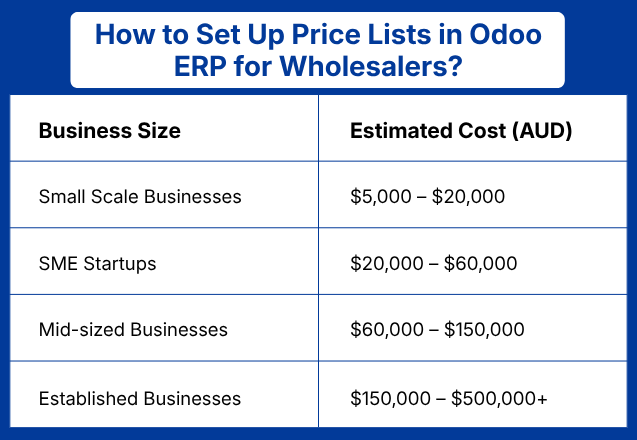
How to Set Up Price Lists in Odoo ERP for Wholesalers?
The answer hinges on a variety of variables, such as the size of the organisation, the number of users, the need for customisation, and the complexity of the installation.
Basic Odoo pricing rules are presented below.
How Do Odoo Pricelists Work and How Do You Set Them Up?
An Odoo sales price list is the engine behind all of this. Each pricelist holds one or more rules. A rule can set a fixed price, a percentage discount, or a formula based on cost or the product’s standard price.
You can point a pricelist at a whole customer group or a single account. Standards can also be established by product, product category, or quantity. Odoo wholesale ERP confirms that its price list applies the matching rule and displays the correct price when a consumer submits an order.
The clever part is layering. You can combine broad rules with narrow ones. A customer might get a general 10 per cent off, plus a sharper price on one hero product they buy in bulk.
Here is a simple way to get started. Follow the steps below in order:
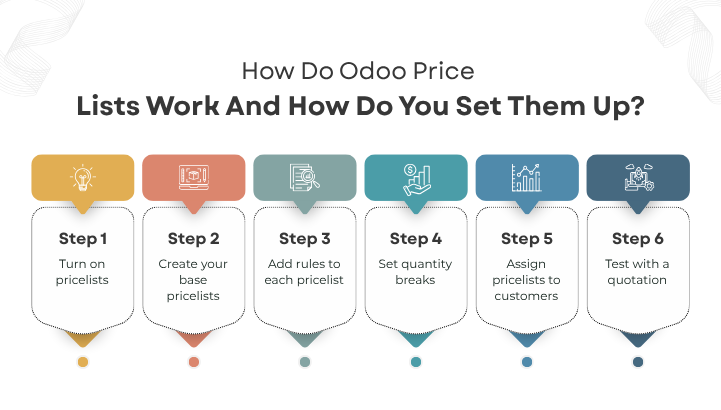
- Step 1: Turn on pricelists. Go to Sales > Configuration > Settings, then enable the pricelist feature.
- Step 2: Create your base pricelists. Build a few tiers, such as Standard, Trade, and Key Account.
- Step 3: Add rules to each pricelist. Set discounts or fixed prices by product, category, or quantity.
- Step 4: Set quantity breaks. Add volume discounts so larger orders unlock better rates.
- Step 5: Assign pricelists to customers. Open each customer record and link the correct pricelist under the Sales tab.
- Step 6: Test with a quotation. Raise a test quote to confirm the right price appears before you go live.
That structure gives you clean, repeatable Odoo price management. No more manual overrides. No more awkward calls from customers who feel short-changed.
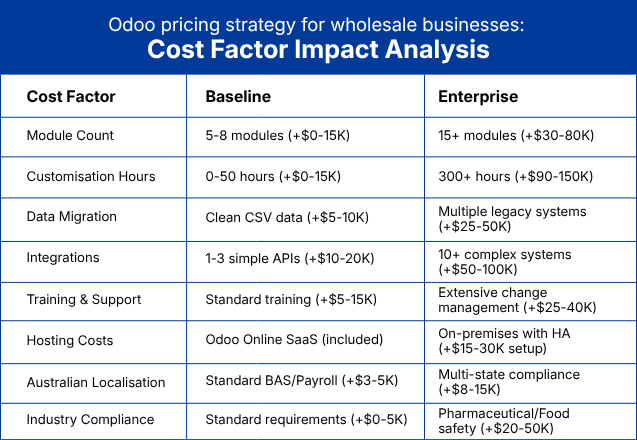
Odoo pricing strategy for wholesale businesses: Cost Factor Impact Analysis
A tool is only as good as its underlying best practices.
So how can a genuine Odoo pricing plan for wholesale companies be formulated?
Start with your costs and your target margin. Know the floor below which no deal should ever go. Next, define your tiers and the rules that separate them. Then decide your discount limits and who can approve exceptions. Finally, move it all into Odoo so the rules run themselves.
Understanding how to create customer-specific pricing in Odoo and how separate aspects affecting total costs aid in prioritising and budget planning:
The shift toward ERP pricing automation is where time savings are realised. Your team stops arguing over prices and starts closing orders. Reports show you which customers and products actually make money. Over time, you tighten the Odoo ERP pricing rules explained and lift your margin without raising a single headline price.
An Odoo wholesale pricing setup also keeps you audit-ready. Every price has a reason and a record. When a customer questions an invoice, you have the answer in seconds.
Therefore, review your Odoo sales pricelists every quarter. Costs, freight, and supplier rates shift constantly in the Australian market. A pricing model you never revisit slowly drifts out of date and leaks profit.
How Envertis Helps With Odoo Customer-Specific Pricing for Wholesalers
Setting all of this up well takes experience. The rules are simple on their own, but a full wholesale model has many moving parts. This is where a specialist partner saves you months of trial and error. Envertis is a certified Odoo Gold partner in Australia. The team works with wholesalers and exporters to design pricing that fits how they already trade.
Envertis develops it around your margins, your clients, and your objectives, from a preliminary pricing list to a fully automated model. Instead of a system that collects dust, you get one your employees will proactively use.

Summing Up
One of the simplest methods to increase earnings is by pricing. To see results, you don’t need more clientele or more items. You just need to know how to set up price lists in Odoo and have control over the prices you already charge.
A clear, customer-specific model in Odoo gives you that control. It keeps your buyers happy, your margins safe, and your team focused on selling. If your pricing still lives in spreadsheets, that is the first thing to fix this quarter.
We work with Australian wholesale businesses at every stage, from initial scoping to post-go-live support. Envertis is a Sydney-based, Gold-certified Odoo partner with 100% client retention across every project we’ve run in Melbourne and beyond.
Frequently Asked Questions
- What is customer-specific pricing in Odoo?
It is the ability to charge each customer a different price for the same product. Odoo does this through pricelists linked to individual customer records, so the correct price applies automatically.
- How does Odoo pricelist work?
A pricelist holds a set of rules. Each rule sets a price, discount, or formula. Odoo checks the customer’s assigned pricelist at order time and applies the matching rule.
- How do I create different prices for different customers in Odoo?
Build a separate price list for the customer, add your rules, and then attach it to their record under the Sales tab. All future quotes and orders will use it.
- Can Odoo manage wholesale pricing?
Yes. Odoo handles tiered pricing, volume discounts, customer segmentation, and quantity breaks. It suits wholesalers who juggle many buyers and negotiated rates.
- Why do Australian wholesalers need customer-specific pricing?
Australian wholesale runs on negotiated deals, freight costs, and tight margins. Structured pricing stops discount creep and protects profit on every order.
- How is an Odoo price list different from a manual discount?
A manual discount is a one-off change someone types on an order. An Odoo price list is a saved rule that applies automatically. Rules stay consistent, so you avoid errors and slow the creep of discounts.
- Can Odoo handle volume and tiered pricing?
Yes. You set quantity breaks inside a price list rule. The price decreases as order size increases, and Odoo automatically selects the correct tier at checkout.
- Does Odoo support pricing in multiple currencies for exporters?
Yes. You can build price lists in different currencies. This lets Australian exporters quote overseas buyers in their own currency without manual conversion.
- Can Odoo automatically apply the correct price to quotations?
Yes. Once a customer has an assigned price list, Odoo applies the correct price to every quote and sales order. Your team does not need to look anything up.
