
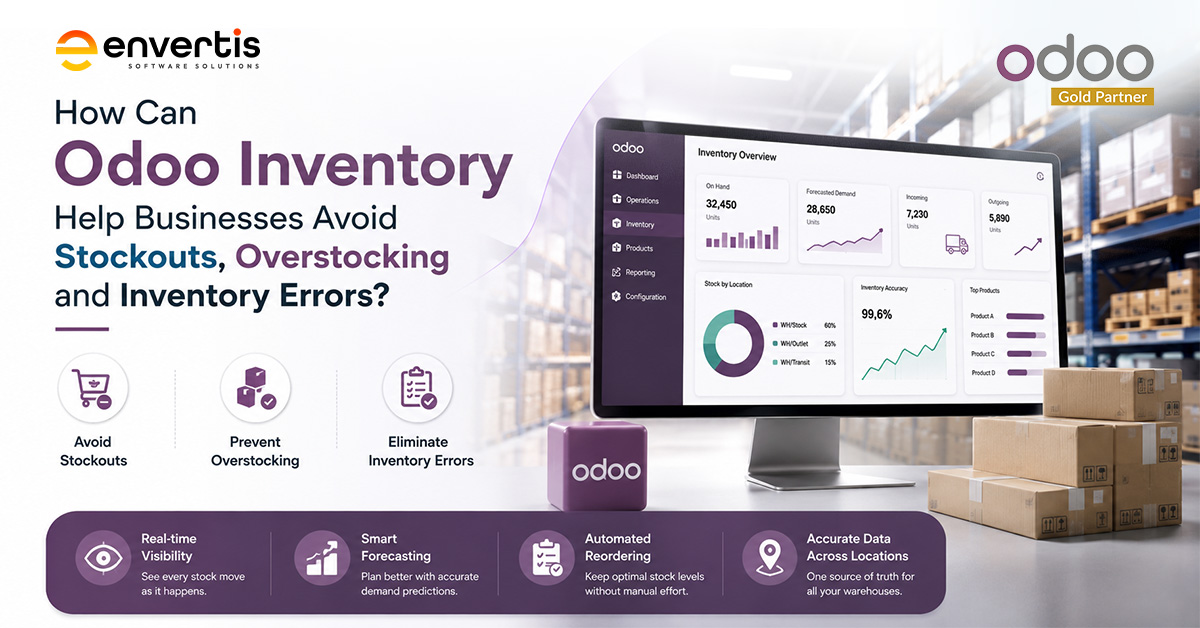
Every Australian business owner knows how frustrating it is when a customer wants to buy something and the shelf is bare.
Or when you are stuck with a storeroom packed with stock that just sits there, gathering dust.
Both situations eat away at your profit, and they usually boil down to the same thing: not really knowing or controlling your inventory.
That is where Odoo Inventory management steps in, giving you a real-time, accurate look at what is in stock, what you have already promised to customers, and what needs ordering next.
Getting inventory right is not a nice-to-have. It decides whether you keep customers, protect cash flow, and grow with confidence. The good news is that a modern Odoo Inventory management software makes all three problems manageable, often within weeks.
This guide explains how the right system stops the three most expensive inventory problems before they start.
The Real Cost of Getting Inventory Wrong
Poor inventory control is not a minor operational annoyance. It is one of the largest sources of hidden loss in retail and distribution worldwide.

Accuracy is the other half of the story.

When your records are wrong roughly one time in three, every reorder becomes a guess.
For an Australian SME, those figures become real money: lost sales, emergency freight, forced markdowns, and hours wasted reconciling spreadsheets. Three problems sit at the centre, and strong Odoo stock management addresses each one.
| Problem | What It Looks Like | What It Costs You |
| Stockouts | Empty shelves, back orders, delayed jobs | Lost sales, lost customers, urgent freight bills |
| Overstocking | Excess stock, slow movers, ageing inventory | Tied up cash, storage costs, markdowns, spoilage |
| Inventory errors | Wrong counts, mispicks, ghost stock | Poor decisions, failed deliveries, unhappy customers |
Signs Your Business Has Outgrown Manual Inventory
Most SMEs do not decide to fix inventory. They hit a wall. If two or more of these sound familiar, you are overdue for a proper system.
- You reconcile stock in spreadsheets but still do not trust the numbers.
- You place rush orders to cover shortages you did not see coming.
- Slow-moving stock keeps building up while cash gets tighter.
- Your online store and your shop floor show different stock levels.
- A full stocktake means closing the doors for a day or more.
If the list feels familiar, a purpose-built Odoo Inventory system will usually pay for itself within a single trading season.
How Odoo Inventory Management Prevents Stockouts
Stockouts happen when demand arrives, and stock does not. A well-configured Odoo Inventory system attacks the problem from several directions at once, so you stop relying on memory and manual checks.
- Real-time stock tracking: Odoo updates stock the moment goods move, so you always know true availability across every location.
- Automated reordering rules: Set a minimum and maximum for each product, and the system raises a purchase order as soon as stock dips below the threshold.
- Demand forecasting: Odoo reads your sales history to predict what you will need, so you order early instead of in a panic.
- Lead time management: Record supplier and production lead times, and time orders to arrive exactly when needed.
- Safety stock buffers: Hold a sensible cushion for unexpected demand without locking up cash.
Together, these features mean less firefighting and more time serving customers. Capable Odoo Inventory management software removes the guesswork behind most empty shelves, and reliable Odoo stock management keeps replenishment running quietly in the background.
This is one reason Odoo Inventory management for Australian businesses has grown quickly among SMEs that have outgrown manual methods.

How Odoo Inventory Helps You Avoid Overstocking
Overstocking is the quieter problem. It does not trigger an angry phone call; it simply sits in the corner, eating your margin. Odoo Inventory gives you the visibility to stop buying stock you do not need.
- Accurate demand forecasting ends the habit of over-ordering just in case.
- Just-in-time replenishment keeps warehouse levels lean by ordering only what current demand supports.
- Inventory valuation reports show the live value of your stock using FIFO, average, or standard costing, so finance always knows what capital is tied up.
- Slow-mover and ageing stock reports flag products that are not selling before they become dead stock.
- Multi-warehouse visibility lets you move stock between sites instead of buying more.
The payoff is healthier cash flow. Money that used to sit on shelves is freed to fund marketing, hiring, or new product lines.
Good Odoo stock management turns excess inventory from a recurring headache into a number you manage on purpose. For wholesalers, Odoo Inventory management for distributors is often the fastest route to lower carrying costs.

How Odoo Inventory Eliminates Manual Inventory Errors
Manual counting and spreadsheets are where accuracy goes to die. Every rekeyed figure is a chance for a mistake, and mistakes compound over time. An Odoo Inventory system replaces guesswork with a single, trusted source of truth.
- Barcode and QR scanning speeds up receiving, picking, and delivery while cutting typing errors to almost nil.
- Cycle counts and inventory adjustments let you check stock in small, regular batches rather than shutting down for a full stocktake.
- Lot and serial number traceability tracks each item from receipt to delivery, which matters for food, medical, and regulated goods.
- Complete movement history shows who did what and when, so you can trace discrepancies easily.
This is how Odoo Inventory helps manage warehouse stock without the endless reconciliation that manual systems demand.
Fixing your records is not just tidy housekeeping either.


Odoo Inventory Features and Benefits at a Glance
What really makes this platform stand out is how everything works together. For a growing SME, here are the Odoo Inventory features and benefits you actually care about.
| Feature | Benefit |
| Real-time tracking | Always know true stock across every location |
| Automated reordering | Prevent stockouts without manual monitoring |
| Demand forecasting | Buy the right quantity and avoid overstocking |
| Barcode scanning | Faster operations and fewer counting errors |
| Lot and serial tracking | Full traceability and simple recalls |
| Inventory valuation | A clear view of capital tied up in stock |
| Multi-warehouse control | Balance stock across sites in a few clicks |
Odoo links inventory directly with sales, purchasing, accounting, and manufacturing. Your Odoo Inventory management software never works from stale data. So, when you make a sale, your stock updates instantly everywhere.
That built-in connection is what powers a solid Odoo Inventory system. It is what separates modern Odoo Inventory stock management software from a bolt-on spreadsheet.
Odoo Inventory for Manufacturers, Distributors and Australian Businesses
Different operations lean on different features, and a good setup reflects that.
Manufacturers
For makers, Odoo Inventory management for manufacturers links raw materials, work in progress, and finished goods in one flow. Bills of materials pull the correct components, and make-to-order rules stop you building stock you cannot sell.
Distributors
For wholesalers, speed and accuracy across many product lines is everything. Cross-docking, smart pick lists, and multi-warehouse routing keep goods moving. Strong Odoo Inventory management for distributors keeps fill rates high and carrying costs low.
Australian businesses
Local operators face particular pressures: long supplier lead times, freight across large distances, and tight margins. Odoo Inventory management for Australian businesses suits these conditions because it adapts to multiple locations, currencies, and tax rules without heavy customisation.
Why Australian SMEs Trust Envertis for Odoo
Software only works for you when it is built around the real way your business operates. With Odoo stock management, the magic isn’t just in the platform; it is in the setup. That is where deep experience really matters.
Envertis has been all-in on Odoo since 2017. We quickly became an Odoo Centre of Excellence in 2018 and hit Gold Partner status in 2024. With over 200 Odoo implementations under our belt and teams based in Sydney, Melbourne, Brisbane, Adelaide, and Perth, we understand the realities of Australian trading conditions.
Whether you have one warehouse or a whole network, Envertis shapes your Odoo system around your products, suppliers, and business goals. We stick with you long after launch to make sure everything runs smoothly. The right Odoo Inventory stock management software should fit your business, not force you to change how you work.

Frequently Asked Questions
Q. What is Odoo Inventory management?
A. Odoo Inventory management handles your stock in real time. It keeps everything connected, including sales, purchasing, and accounting, so your numbers match up across the board. The Odoo Inventory management software works just as well for a single warehouse as it does for a full network of locations, and it adapts as your business grows.
Q. Can Odoo prevent stockouts automatically?
A. Yes. Odoo’s reordering rules and demand forecasting mean you don’t have to keep checking your stock every day. The platform automatically kicks off purchase orders before you run out, factoring in expected lead times, so you never lose track.
Q. Is Odoo Inventory suitable for small Australian businesses?
A. It is. The system scales from a single store to a national operation and handles local tax, multi-location, and multi-currency needs, making it a practical fit for growing SMEs.
Q. How does Odoo reduce inventory errors?
A. Barcode scanning, regular cycle counts, and full traceability by lot and serial numbers eliminate manual-entry mistakes. Everything syncs up, so you always know exactly what you have in stock, no matter how fast you grow.
Q. Does Odoo Inventory work for manufacturers and distributors?
A. Yes. It supports bills of materials and make-to-order flows, so Odoo Inventory management for manufacturers works well, alongside cross-docking, pick lists, and multi-warehouse routing for distributors.
Q. How long does an Odoo Inventory implementation take?
A. Timelines vary with complexity, but a focused SME rollout often goes live within a few weeks. An experienced partner such as Envertis will scope this accurately after reviewing your products and processes.
