
It’s 7 am on the factory floor.
You’ve got three spreadsheets open, two of them last updated yesterday afternoon, and a client on the phone asking whether their order will ship on Friday.
You scroll, cross-reference, squint at a formula that someone broke two months ago — and you still can’t give a confident answer.
If that scenario feels familiar, you’re not alone. Hundreds of Australian manufacturers are running complex production operations on tools that were never designed for the job. And the cost — in time, rework, missed deliveries, and margin erosion — adds up faster than most business owners realise.
This is why Odoo for Manufacturing is gaining serious traction across Australian factory floors. More manufacturers are moving from disconnected spreadsheets to a single, purpose-built system that provides their teams with live production data, automated planning, and real control over the shop floor.
This blog walks through exactly how they’re doing it — and what becomes possible when you stop managing manufacturing in Excel.
The Hidden Cost of Running Manufacturing on Spreadsheets
Spreadsheets aren’t wrong — they’re just wrong for this. When your production manager is the only person who knows which BoM version is current, or when your job cost summary is always running 24 hours behind, you’re not managing operations. You’re managing spreadsheets.
Based on Envertis’s assessments with manufacturing clients before implementation, here’s what that actually costs Australian manufacturers:
- 5–15% of production costs are lost to rework due to BoM errors, miscommunication between teams, or outdated planning data.
- 8+ hrs per week spent by operations managers manually updating, reconciling, and distributing spreadsheet-based schedules.
- 23% of manufacturers cite poor inventory visibility as a direct cause of production delays, according to industry research.
- $0 audit trail — when quality issues arise, spreadsheets offer no reliable batch traceability to isolate and contain the problem.
Beyond the operational drag, there’s a compliance dimension. Australian manufacturers working in food and beverage, medical devices, or industrial components face growing regulatory expectations around traceability, batch records, and quality sign-off. A shared Excel file doesn’t cut it when an auditor walks in.
And the financial risk is real. When job costing is manual, margins are guesswork. You might only discover a job ran at a loss weeks after it shipped — when there’s nothing left to do about it.
The question isn’t whether spreadsheets are causing problems. It’s how much those problems are costing you — and what the alternative actually looks like.
What Is Odoo Manufacturing ERP — And Why Are Australian Manufacturers Choosing It?
For Australian manufacturing SMEs — typically 20 to 300 employees — manufacturing ERP software Australia options have historically meant either overbuilt enterprise systems or under-powered accounting bolt-ons.
Unlike traditional ERP software that sells you a monolithic system with features you’ll never use, Odoo lets you activate the modules your business actually needs — and add more as you grow.
For manufacturers, the core modules include:
- Manufacturing (MRP)— production orders, routing, work centres, and capacity planning
- Bill of Materials— version-controlled BoM management with multi-level structures
- Shop Floor— real-time work order tracking with tablet-friendly interfaces for the floor
- Quality— inspection points, quality alerts, and batch traceability
- Inventory— demand-linked stock management with automatic replenishment rules
- Accounting— integrated job costing that updates in real time as materials and labour are consumed
As Odoo ERP for manufacturers, it’s priced at a fraction of what SAP Business One or MYOB Advanced typically costs — and with local Odoo implementation partners available across Australia, you’re not dependent on offshore support.
Odoo sits cleanly in the middle: genuinely capable, locally supported, and configurable to your industry without requiring a six-figure implementation budget.
That combination is why more manufacturers in Sydney, Melbourne, Brisbane, and regional centres are choosing it.

5 Ways Australian Manufacturers Are Using Odoo to Ditch Spreadsheets
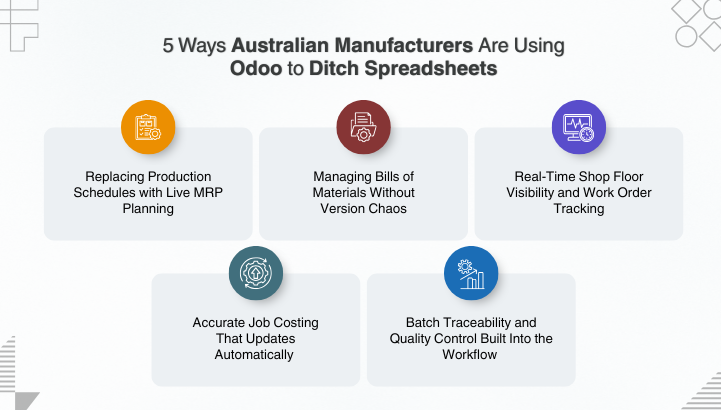
1. Replacing Production Schedules with Live MRP Planning
A production schedule that lives in Excel is always a snapshot — accurate when it was saved, outdated the moment anything changes.
Odoo’s MRP engine connects sales orders, inventory, capacity, and work centres into a live planning model. When conditions change, the system flags what needs to move — and planners can reschedule directly without rebuilding anything from scratch.
Use Case: A metal fabricator in Western Sydney cut their daily planning meeting from 45 minutes to a 10-minute floor walk. The schedule was already updated. The decisions were already made.
2. Managing Bills of Materials Without Version Chaos
In any manufacturer with more than a few product lines, BoM version control is a recurring nightmare. When engineering updates a component spec, how long does it take for the floor team to know? How do you ensure the right version is being used for each job? With spreadsheets, the answer is usually “it depends who you ask.”
Odoo’s BoM module maintains a single source of truth with version history, effective-date control, and automatic application to new manufacturing orders. Engineers update the BoM once. The floor sees the right version immediately.
Use Case: A precision plastics manufacturer in Brisbane stopped asking “which BoM are we on?” the week Odoo went live. There’s only one answer now. Engineering owns it. The floor trusts it.
3. Real-Time Shop Floor Visibility and Work Order Tracking
When a supervisor has to walk the floor to physically assess WIP status, production reporting is already a full shift behind. When a customer asks, “Where’s my order?”, the answer is a best guess, not a fact.
Odoo’s Shop Floor module runs on standard tablets mounted at each work centre. Operators log start and stop times, record material consumption, and flag quality issues — all without leaving the machine. Managers see live WIP status across the entire floor from any device.
Use Case: A regional Victorian food processor stopped doing end-of-shift production reports six weeks after Odoo went live. Not because anyone decided to. Because nobody needed them anymore.
4. Accurate Job Costing That Updates Automatically
When job costing is assembled manually from timesheets, purchase receipts, and stock movements — all pulled together at the end of the week — your margin visibility is always historical. You find out a job was unprofitable after you’ve already invoiced it.
Odoo integrates manufacturing operations directly with accounting. Every material consumed, every labour hour logged, and every subcontract operation updates the job cost in real time. Managers can see the margin against the estimate before a job even ships.
Use Case: A Melbourne-based packaging manufacturer identified three loss-making product lines during its annual review. With Odoo, they would have found out on the third production run. They would have done something about it on the fourth.
5. Batch Traceability and Quality Control Built Into the Workflow
When a quality issue surfaces — a contaminated batch, a component failure, a customer complaint — tracing it back to its source using spreadsheets and paper records can take days. In regulated industries, that’s not just slow. It’s a compliance risk.
Odoo’s lot and serial number tracking, combined with its Quality module, gives manufacturers full forward and backward traceability — from raw material supplier through to finished goods delivery. Quality checkpoints are built into work orders, not tacked on as an afterthought.
Use Case: An Adelaide beverage manufacturer once spent three days tracing a quality complaint back to a supplier lot. After Odoo, they ran the same trace in eight minutes. The three-day version never happened again — but they know exactly what it would cost if it did.
How Envertis Helps Australian Manufacturers Implement Odoo
Envertis is an Australian Odoo implementation partner with a focus on manufacturing, distribution, and operations-heavy businesses. Our team works alongside your operations and production staff to configure Odoo to your specific workflows — not a generic template — and delivers phased rollouts that keep your floor running while the system goes live. We provide hands-on training for both floor staff and management, and we’re available locally to answer questions after go-live.

Expert Answers to Common Questions
Q. What is Odoo Manufacturing ERP?
A. Odoo Manufacturing ERP is built to handle pretty much everything you need in the manufacturing process. You get production planning, bill of materials management, shop floor control, quality checks, and job costing—all in one place. And since it’s all connected, your manufacturing team works directly with inventory, procurement, and accounting—no more scattered spreadsheets or jumping between different programs.
Q. Can Odoo replace spreadsheets for production planning?
A. Yes. Odoo’s MRP module doesn’t mess around with those old-school, manual production schedules. Instead, it gives you live planning that automatically updates as inventory shifts, machines go offline, or sales orders pile up. Managers see up-to-date work orders, track capacity, and check material levels without fiddling through endless files.
Q. How long does an Odoo manufacturing implementation take?
A. If you’re running an Australian SME and want to set up Odoo manufacturing, it usually takes somewhere between 8 and 20 weeks. The timing depends on stuff like how many modules you need, how much data you have to migrate, and how complex your workflows are. Lots of companies start with manufacturing and inventory first, then add accounting and quality control later—so you get up and running quickly with minimal hassle. Envertis uses a structured methodology to keep implementations on track and on budget.
Q. Does Odoo work for small Australian manufacturers?
A. Odoo works well for manufacturers with teams of 15 to 300 people. The best part is, you only pay for the modules you actually use, so smaller businesses aren’t stuck with extra costs. A lot of small manufacturers in Australia jump in by setting up just the manufacturing, inventory, and accounting modules. Later, they add more when things pick up. And since Odoo is built for the cloud, you don’t have to deal with servers or extra IT headaches—making life easier for smaller teams.

