
ERP or Enterprise Resource Planning is the core of efficient business operations in modern times. So, what does ERP mean? Simply put, ERP is a software used to centralise and automate business processes to enhance efficiency and enable better-informed decisions.
According to DocuClipper, the global ERP market size is expected to reach $123.41 billion by 2032. It means that today, businesses rely on ERP to strengthen productivity for long-term success.
Now, considering the Australian market, ERP is one of the most promising tools for organisations of all sizes to boost sales and ROI. So, ERP automation is not a buzzword anymore, but a growth enabler for modern businesses. Speaking of automation in ERP, apart from technology, it is a game-changer in reshaping how enterprises work and deliver results to stay competitive.
So, in this blog, we will delve deeper into understanding what ERP automation is and how it matters for Australian businesses in driving operational efficiency.
What is ERP Automation?
The integration of state-of-the-art technologies, like Artificial Intelligence (AI), Machine Learning (ML), Optical Character Recognition (OCR), and Robotic Process Automation (RPA), into an ERP system to automate routine operations is known as ERP automation.
ERP systems like Odoo, SAP S, Microsoft Dynamics 365, and Oracle NetSuite use various automation integrations into HR, finance, inventory, supply chain, customer relationship management, etc., modules to eliminate repetitive tasks and human error and support efficient workflows. Thus, automating your ERP system helps you make smarter decisions and scale effortlessly.
How ERP Automation Is Different From Traditional ERP Systems
Typically, traditional ERP relies on manual input, which is time-consuming and often accompanies human errors, resulting in reduced productivity and scalability.
Here is a significant difference between ERP automation and traditional ERP:
| Characteristics | Traditional ERP | Automated ERP |
| Human Involvement | Tasks like workflow approval and data entry require considerable human involvement. | Minimal human intervention due to the significant use of AI. |
| Security | Storage is generally not cloud-based, which increases the chances of cyber threats. | Enhanced security because of cloud-based storage. |
| System Updates | To improve scalability and security, repeated manual updates are necessary. | Updates occur automatically due to AI and ML integration, curtailing operational disruptions. |
| Affordability | It is more expensive as there is a need for persistent maintenance. | As the maintenance cost is low, it is a more cost-effective choice. |
Business Benefits Of ERP Automation
Let’s not forget that in the era of large-scale automation across various industries, you cannot expect to scale and grow a business with traditional ERP systems. For example, Odoo ERP automation is notably adopted for strategic, operational, productive, and financial benefits.
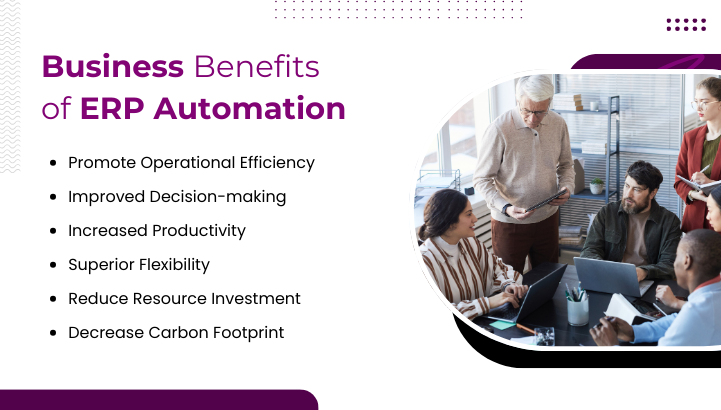
Here is a detailed illustration of the top 6 benefits of ERP automation for businesses of every size and sector:
Promote Operational Efficiency
When you automate tasks, it naturally gets streamlined. Streamlining operations not only saves time but also reduces human error. Additionally, a centralised database curtails data silos, enabling better collaboration across teams. As a result, there is increased efficiency.
Improved Decision-making
With Odoo ERP automation, you get real-time data analysis and predictions that help in making better and faster decisions. In other words, as you can identify the assets and bottlenecks in your business, you become more confident about making critical decisions.
Increased Productivity
Naturally, when you automate repetitive tasks, your employees can concentrate on high-value activities like planning, customer service, etc., which maximises productivity. It leads to higher sales and profit.
Superior Flexibility
Do you know what the best part of ERP automation is? No matter where you are, you can access data and manage operations remotely. This leads to undisturbed business processes and the ability to deliver optimal customer experience.
Reduce Resource Investment
As you automate daily tasks, the need for manual labour decreases significantly. It means that with fewer resources, you can provide more efficient results. No additional costs, rework, or delays!
Decrease Carbon Footprint
With sustainability taking over every aspect of our lives, shifting your business operations to the digital platform is one of the best ways to reduce paper waste. Automating ERP is indeed an environmentally friendly approach for man and Nature!
Top 5 ERP Automation Applications
Needless to say, Odoo ERP automation simplifies complex business processes for enhanced agility and scalability. From finance and accounting, sales and CRM, manufacturing and inventory, to human resources and payroll and supply chain, every sector in an economy benefits from automating and streamlining its operations.
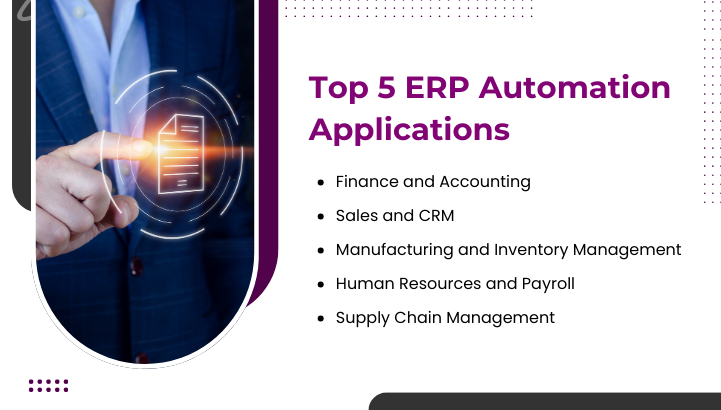
Let’s take a look at the top 5 use cases of ERP automation for tangible results.
Finance and Accounting
Data accuracy and invoice processing are two of the most important aspects in the finance and accounting sector. Thanks to ERP automation, which effortlessly collects, consolidates, and processes financial data. Manual invoicing leads to duplicate, mismatched, or missing data, which delays the payment cycle. However, auto-generated invoices, receipts, and reports eliminate bottlenecks and strengthen cash flow.
Sales and Customer Relationship Management (CRM)
A seamless customer experience is undoubtedly the secret behind increased sales and brand loyalty. When you automate lead generation, order processing, and invoicing, evidently, there are reduced errors and increased accuracy. What happens next? Your customers are happy, sales rise, and profits increase. Thus, the acquisition and retention of customers becomes smooth and easy.
Manufacturing and Inventory Management
When you integrate manufacturing and inventory into Odoo ERP automation, you gain better control of production planning and supply chain, leading to higher precision. It means precision and accuracy become your most valued tools for growth and expansion. MRP or BOM—you do not have to rely on spreadsheets! Gain superior shop floor visibility with manufacturing and inventory management.
Human Resources and Payroll
No matter what the size of your organisation is, keeping your employees happy boosts productivity and delivers a positive brand reputation. Talent acquisition, onboarding, and managing payroll are the keys to ensuring your HR team can put away headaches and employees enjoy a compliant workspace. ERP automation typically addresses all the pain points for superior performance and workforce administration.
Supply Chain Management
Through advanced tools like predictive analytics and AI, it is easy to make decisions and avoid stockouts and overstocking. Gaining real-time visibility helps businesses forecast demand changes and respond immediately, naturally improving efficiency.
How To Get Started With ERP Automation?
For the successful implementation of any ERP system, it is necessary to have a strategic plan and take a step-by-step approach. So, how to get started?
Here is a detailed illustration of Odoo ERP automation implementation:
Analyse Needs
Recognising business requirements provides you with a roadmap to your goals. So, you have to assess the pain points and the distinctive areas that will benefit from automation.
Pick Your Module
Once you learn about your requirements, seek a solution that complements them. HR, CRM, or POS—choose your ERP automation module that can seamlessly integrate with your existing system and fulfil your needs. You may require multiple modules to handle diverse processes.
Launch a Pilot Project
To reduce error and minimise processing time, begin automation in a single module. Once you have validated outcomes, proceed with other modules. This helps in generating focused outcomes.
Train and Monitor
Before scaling, train your team for quick adoption. Thorough user training is necessary to avoid disruptions and ensure smooth expansion. Additionally, tracking KPIs like productivity gains, cost savings, etc., helps you identify areas of improvement and automation scope.
Technologies Powering ERP Automation
Automation relies entirely on the technology stack. No matter which module you choose, a suite of advanced and powerful technologies is the cornerstone of ERP automation.
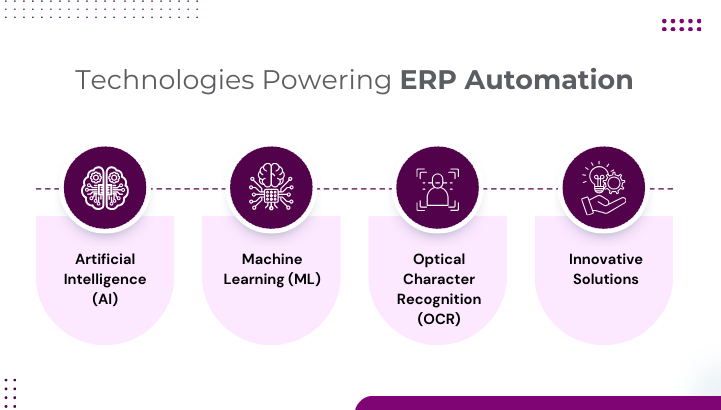
Following is the list of the technology stack for automating ERP:
Artificial Intelligence (AI)-
According to a recent research by Threadgold Consulting, 85% of ERP vendors depend on AI for automation. AI implementation is observed in every aspect of the digital era. From assessing bottlenecks to providing recommendations, Odoo ERP automation is powered by Artificial Intelligence across diverse features.
Machine Learning (ML)-
How do you receive demand forecasting? Obviously, ML play a crucial role not only in forecasting demand but also in error detection, adaptive scheduling, and cash flow prediction.
Optical Character Recognition (OCR)-
Feed structured data into the ERP system from invoice, form, or receipt data. It reduces manual errors to a substantial extent.
Robotic Process Automation (RPA)-
Eliminates repetitive tasks for superior accuracy and efficiency. Invoicing, reconciliation, data entry—everything depends on RPA.
The Future of ERP Automation
Technology advancement is going nowhere! Hence, in the coming times, you will observe significant ERP automation features that will transform how businesses work and grow effortlessly.
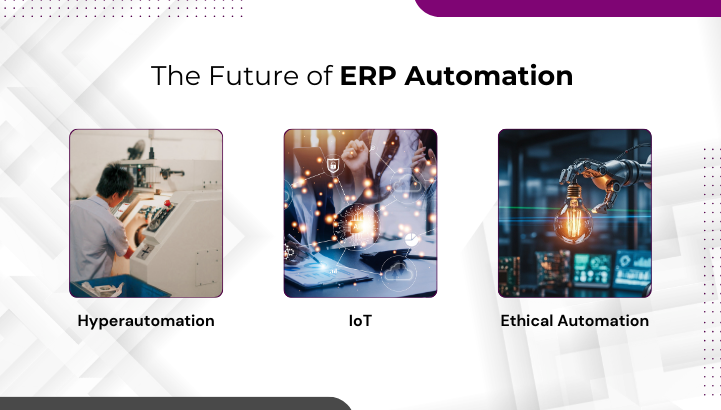
What are they?
Hyperautomation-
Businesses will integrate RPA, AI, APIs, and low-code platforms to build flexible ERP ecosystems aligned with their unique workflows.
IoT-
ERP modules will be fed with real-time sensory data across logistics, field operations, and manufacturing for increased visibility.
Ethical Automation-
Control and transparency are becoming relatively important with the rise of automation. As a result, AI will adhere to ethical standards and compliance.
How Can Envertis Help You with ERP Automation?
Envertis integrates seamlessly with leading ERP platforms, including Odoo, SAP, NetSuite, and Microsoft Dynamics 365. This broad compatibility resolves a common business challenge—connecting automation solutions with existing ERP environments. By removing integration complexities, Envertis ensures a smooth, efficient implementation, even for organisations that have struggled with ERP integrations in the past.
Frequently Asked Questions
Q. What is ERP automation?
A. ERP automation is the process of automating repetitive tasks within Enterprise Resource Planning software to streamline business operations and eliminate human errors. It offers a centralised platform for enhanced real-time visibility to promote efficiency and make better-informed decisions.
Q. What are the technologies used in ERP automation?
A. To automate ERP systems like Odoo, SAP, Microsoft Dynamics 365, and NetSuite, technologies like Artificial Intelligence (AI), Machine Learning (ML), Optical Character Recognition (OCR), and Robotic Process Automation (RPA) are integrated into the system.
Q. Which business processes are automated through ERP?
A. The business processes that are automated through ERP include finance and accounting, human resources and payroll, manufacturing and inventory, supply chain, and sales and customer relationship. Unifying all the operations into a single platform encourages precise data accuracy for consistent scalability across all departments.

