
It is 16:50 on a Friday.
To try and find out the status of their Tuesday purchase request, a client just sent an email. The sales associate opens the first document and then the second before contacting the warehouse staff for assistance. Two people go looking. Ten minutes later, the answer came back: the stock was sold that morning, to someone else, and nobody had updated the file yet.
Nothing about that scene involves a lack of demand. Most distribution businesses do not fail because customers stop buying. They slow down because their systems cannot keep pace with the volume moving through them.
This is where Odoo for distribution starts to matter. Taking a thriving distributor from a series of spreadsheets to one connected system is not just about cleaning things up. This transition helps to speed up the process, provide more accurate data, and relieve stress for the people working in the distributor.
This blog covers the issues of a mid-sized distributor that moved from spreadsheets to an integrated system and reduced its administration time by 40 per cent.
Common Business Challenges of Distribution Processes
Operations had swiftly outgrown the solutions that put the business together. Without distribution management software, orders were still in spreadsheets, email correspondence, and heads.
This was acceptable when the business was small but suddenly became a problem. These occurred frequently, not as rare events.
- Manual data entry across multiple systems
Every customer order was typed out by hand, then typed again into a second system, and sometimes a third. The same information, sitting in different places, entered by different people. Double the work meant double the errors.
- No visibility into order status
Nobody could say with confidence where an order actually stood. Was it in manufacturing? Sitting in quality control? Packed and ready to ship? Finding out meant asking three separate people and hoping their answers matched.
- Errors and rework eating into margins
Not comprehending orders accurately resulted in wrong specifications used in production. Approximately 15% to 20% of the orders had to be redone. Meaning that material, machines, and labour were used a second time for the same production.
- Slow order processing
Moving an order from receipt to manufacturing handoff took 8 to 12 days on average. Cutting that window to 2 to 4 days is where the 70 per cent improvement came from.
None of this called for a heavyweight enterprise platform. What the business needed was Odoo inventory management that removed the friction at each of these points. By this stage, it had stopped being a nice-to-have and become a matter of staying competitive.
How Distribution ERP Software Brings All Your Business Operations Together
Now for the other side of the ledger. The point of moving to Odoo distribution ERP is not to own better software. It is to delete the tasks that generate the costs above. When the same data is entered once and shared across sales, stock, and finance, most of the hidden bill simply disappears.
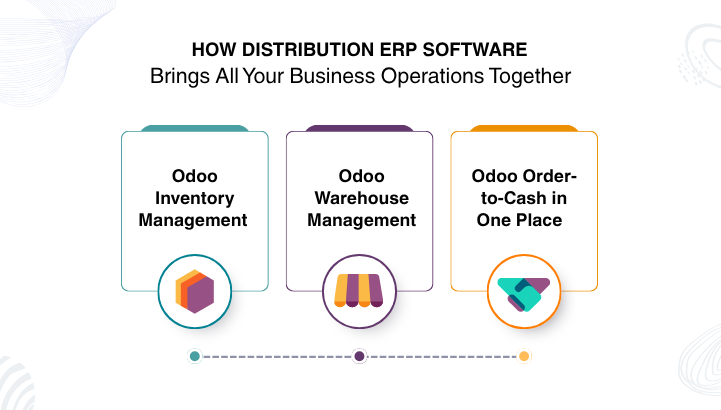
- Odoo Inventory Management
At the centre sits Odoo inventory management, which tracks every product across every location in real time. When a delivery arrives, the count updates. When an order ships, the count updates again. There is no separate stock sheet to maintain, because the stock record and the transaction are the same event.
- Odoo Warehouse Management
This further adds an operational layer on top. You can set up multi-step receiving, define picking routes, and use barcode scanning to reduce human error at the point where most inaccuracy creeps in. For a business trying to improve inventory accuracy with Odoo, this is where the gains come from. Accuracy improves because the count is a by-product of doing the work, not a separate chore done later.
- Odoo Order-to-Cash in One Place
The second big win is the order-to-cash flow. A confirmed quotation becomes a sales order. That order reserves stock, drives the delivery, and produces the invoice. Because each step reads from the same record, the numbers cannot drift apart.
The practical benefits of Odoo for distribution companies show up here:
- Fewer manual handoffs, which means fewer places for errors to enter.
- Faster invoicing, because billing is a click rather than a re-entry task.
- Clearer visibility, because sales, stock, and finance share one dataset.
- Better decisions, because the reports reflect what is happening now.
This is the difference between distribution management software that simply stores data and a platform that moves work through the business.
The distributor in the title of this article reclaimed 40 per cent of its admin time by making exactly that shift. The saving came not from working faster, but from removing re-entry and reconciliation that no longer had a reason to exist.
For any distributor trying to reduce admin time with Odoo ERP, that is the mechanism, and it compounds as volume grows. It is also one of the clearest benefits of Odoo for distribution companies.
Why Choosing Envertis as Your Odoo Implementation Partner Actually Matters
Odoo for distribution is the same software for everyone. The only thing that changes from one project to another is the judgment applied to it. A partner who knows where your orders actually flow through the organisation will set up the routing formulas, approvals, and inventory placement accordingly.
A reliable ERP automation company typically brings:
- Experience across multiple industries
- Proper discovery before implementation, instead of a one-size-fits-all rollout
- Post-go-live support, since reporting needs change as the business changes
- Training for your team, so reports aren’t dependent on one technical person
If you’re evaluating spreadsheet-to-ERP migrations or just want to understand what a proper setup looks like, you are in the right place.

A Side-by-Side Comparison of Your Process With Odoo Distribution Management Software
Seeing the two approaches side by side makes the gap easier to judge. The table below sets out how manual reporting habits help reduce Admin time with Odoo ERP.
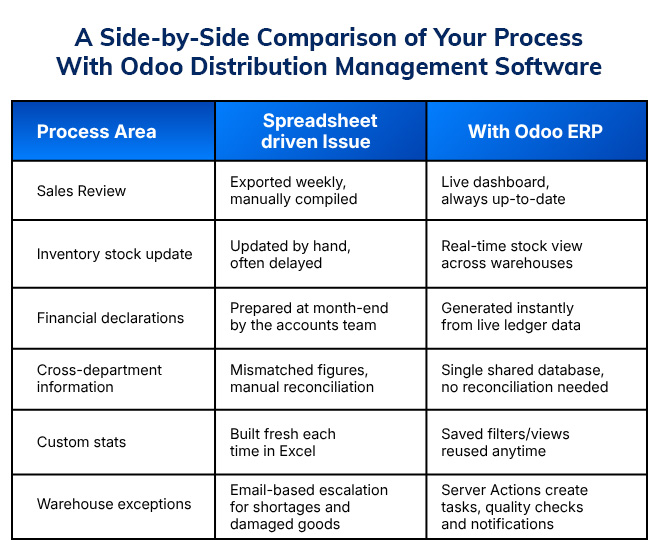
None of this is magic. It is simply what happens when you remove the manual step sitting between the data and the decision.
How to Replace Spreadsheets with ERP: Envertis’ Phase-Wise Implementation Approach
Envertis delivers Odoo in defined phases so the spreadsheet to ERP migration happens with control, clarity, and no disruption to daily operations.
Each phase stands on its own, which means you see returns before the next stage begins.
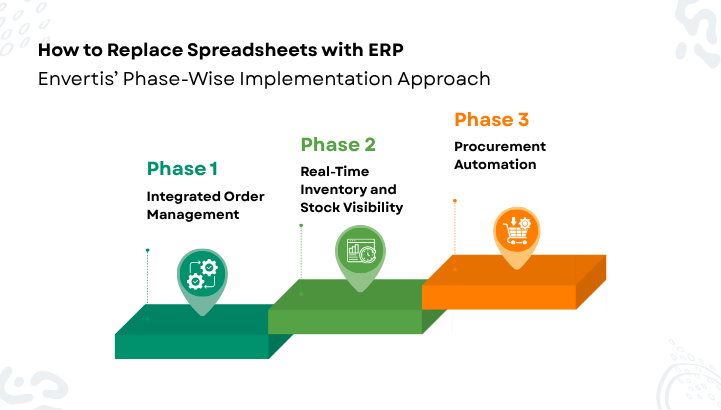
- Phase 1: Integrated Order Management
We begin our discussion with order management, since it is where most of the friction occurs. Orders are processed instantly when they come in, which means there is no need for humans to enter information and achieve a 90% reduction in inaccuracies. In this way, instead of spending all of their time correcting errors that occurred during data entry, your personnel can spend it dealing with unique situations that require human input.
Real-time availability dashboards can view stock in all warehouses from one place. No more ringing each location to find out what is on the shelf. For a growing wholesaler, this is usually the first sign that an Odoo ERP for small distribution business operations can hold its own against far more expensive systems.
- Phase 2: Real-Time Inventory and Stock Visibility
Next, we connect inventory and sales so the two never drift apart. The stock levels are adjusted right after the sale is recorded, which prevents selling stock that does not exist at the point of sale.
We set up low-stock alerts and automatic reorder notifications so the system flags issues before the customer faces them. The dashboards are designed around the KPIs your team uses instead of pointless measures. This phase is where most clients improve inventory accuracy with Odoo to a level they can genuinely plan against.
- Phase 3: Procurement Automation
The final phase automates replenishment. Setting SMART reordering points means using your own sales records and seasonal patterns, eliminating guesswork in order management.
Procurement analytics will reveal your suppliers’ delivery timeliness, and we will track lead times and automate supplier follow-ups. Between the three phases, most distributors reduce admin time with Odoo ERP by a margin they can measure in staff hours per week.
Following this phased approach lets you build automation into your processes without disrupting the work already in motion, and it makes far better use of what Odoo can actually do.
Done properly, the system carries the routine load on its own and needs very little manual oversight, which frees your team to spend its time on growth rather than admin.
Final Words
Odoo ERP for distribution business has moved from interesting to relevant; the next step costs nothing but time. Use the three-point method above to estimate your spreadsheet tax. Take one order and trace every manual touch from request to payment. The number you reach is your business case in miniature, and it belongs to you, not to a vendor.
From there, a specialist partner can pressure-test your figures and scope a sensible first phase. Envertis, a Gold-certified Odoo partner, has delivered more than 75 implementations for SMEs and mid-market businesses across Australia, and works with distributors to do exactly that, from the first estimate through go-live and the tuning that follows. The goal is a decision you can defend to your board, backed by your own numbers rather than someone else’s promises.

Frequently Asked Questions
- How long does an Odoo implementation take for a distributor?
A focused first phase covering sales, inventory, and invoicing often runs in weeks rather than months. The number of occurrences you oversee and the quality of the data determine the timetable. The first project is kept brief and low-risk by starting with a fundamental scope.
- Will I lose my spreadsheet history when I migrate?
No. Your current product, customer, and transaction data migrate into the new system during a good spreadsheet-to-ERP transfer. Your data will migrate more easily if it is tidy beforehand. Nothing is thrown away, and your history becomes searchable rather than scattered.
- Can Odoo handle multiple warehouses and locations?
Yes. Odoo warehouse management supports multiple warehouses, sub-locations, and inter-warehouse transfers within one platform. Stock stays visible across every site in real time, which is a common reason distributors move away from separate spreadsheets per location.
- What if we outgrow Odoo as we scale?
Many people share the same concerns. The software is designed so you can expand it by adding features and users, regardless of your business size or domain.
- Is Odoo available in the cloud or only on-premises?
Both. You can run Odoo as a hosted cloud service or on your own infrastructure, depending on your control, security, and budget preferences. A partner can help you weigh the trade-offs during the Odoo implementation, so the hosting choice fits your business rather than the other way around.
- How do we get the team on board?
Change is effective when the individuals carrying out the task are included in the process of preparing for it. It is important to involve primary users from the very beginning, prepare training sessions for them that focus on their roles rather than different features, and explain to each user how the system simplifies the tasks they find most difficult. When it becomes obvious that the system makes the work easier, it will be accepted willingly without resistance.
- Is Odoo a good fit for a small distribution business?
It can be a strong fit. Because you enable only the modules you need, an Odoo ERP for a small distribution business stays lean and affordable, then grows as you do. The deciding factor is rarely size on its own. It is how much manual re-entry and reconciliation you carry, which is where even smaller operations often find the case stacks up.
