

Choosing between a big-bang and a phased Odoo ERP rollout affects risk and adoption. Learn why Envertis recommends a smarter, phased strategy.
ERP projects don’t fail because of bad software.
They fail because of the wrong rollout strategy.
When implementing Odoo ERP, one decision shapes everything that follows:
Do you deploy everything at once in a “Big Bang” rollout?
Or implement strategically through phased deployment?
That choice can accelerate transformation or cause disruption.
For Australian SMEs and growth-focused organisations, selecting the right Odoo ERP rollout strategy is not just a technical decision. It’s a business-critical one.

Why Rollout Strategy Matters More Than You Think
Installing software is only one aspect of Odoo implementation. It’s about fundamentally changing the way your company runs.
Odoo, a unified ERP platform, integrates sales, inventory, finance, HR, procurement, CRM, and reporting into a single ecosystem. When you put it into practice, you’re changing the operational basics of the business rather than just implementing a piece of software.
This transition determines far more than technical success. It impacts:
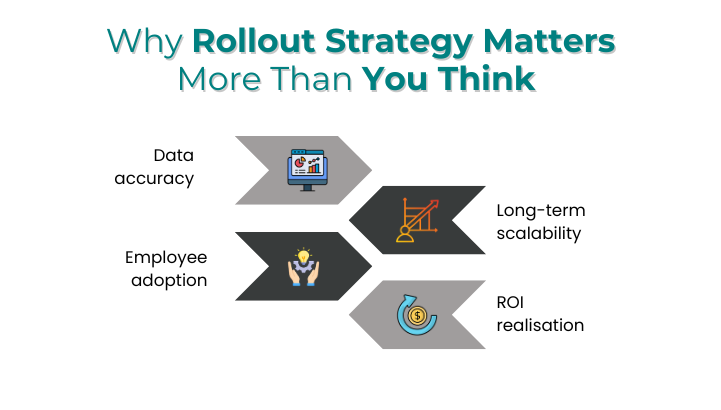
- Employee adoption and resistance levels
- Operational disruption during go-live
- Data accuracy and reporting reliability
- Speed of ROI realisation
- Long-term scalability and system performance
A carefully phased approach reduces risk and builds confidence department by department. It ensures each module delivers measurable value before expanding further. In complex, unified platforms like Odoo, strategy doesn’t support implementation; it determines whether the implementation succeeds at all.
ERP Adoption Strategies: Phased vs Big-Bang Rollout
Choosing the right ERP implementation approach will directly impact operational stability, cost control, and speed to value. Below is a concise breakdown to help clarify the decision.
Big-Bang ERP Implementation
A single, organisation-wide go-live where the entire ERP system is deployed at once.
Why Some Businesses Choose It:
- Faster transition to a fully integrated ERP environment
- Shorter overall implementation timeline
- Lower extended project management overhead
- Immediate access to complete system functionality
- Quicker potential ROI realisation
Risk Profile:
- Higher operational disruption if issues arise
- Limited real-world testing before full launch
- Greater dependency on upfront planning accuracy
- Increased pressure on teams during go-live
- Harder to isolate and correct early-stage errors
Phased Odoo ERP Implementation
Often, the smarter strategy for growing businesses is a phased rollout that introduces ERP modules in controlled stages rather than all at once.
By deploying an Odoo ERP system incrementally, businesses can test, adapt, and stabilise each function before expanding further.
Why It’s Frequently Preferred:
- Lower implementation risk
- Controlled testing and optimisation at each stage
- Minimal disruption to daily operations
- Better user adoption and training outcomes
- Clear performance visibility before scaling further
While it may extend timelines and require sustained coordination, it significantly reduces operational shock and protects business continuity.


How to Choose the Right Approach?
Consider the following standards to help you guide your approach.
- Business size
A full-scale, big bang implementation can be the quicker choice if your business is small. On the other hand, it is typically best for a multi-site business.
- The digital maturity
Even with a big bang strategy, adoption will go more smoothly if your people are already accustomed to using digital tools.
- Resource availability
Teams will be very involved throughout a big bang implementation because most of the work is done up front. A phased approach, on the other hand, divides the effort equally.
- External milestones
A big-bang deployment is often the better option in these situations. On the other hand, it is safer to implement gradually in phases.
Why Envertis Recommends a Smarter Odoo ERP Rollout
At Envertis, we recommend phased Odoo ERP implementation for most SMEs and growth-oriented organisations.
Not because it’s slower.
But because it’s smarter.
Our approach focuses on:

- Detailed business requirement mapping
- Workflow alignment before configuration
- Identifying high-impact modules first
- Validating performance metrics at each stage
- Expanding only after stability is proven
The phased rollout method:
- Protects revenue streams
- Improves staff adoption
- Enhances reporting accuracy early
- Reduces operational shocks
- Preserves long-term ROI
Odoo ERP is designed to scale. A phased rollout allows that scalability to unfold in a controlled, measurable way.
Risk vs Reward: What Business Leaders Must Evaluate
ERP is not just an IT investment; it is a strategic decision to invest in an ERP system. Even if big-bang deployment provides quick access, it also carries some risks. Stronger adoption, quantifiable value, and organised progress are achieved through staggered implementation.
Odoo ERP implementation success for growth-oriented businesses centres on both carefully choosing the platform and putting it into practice.
When deployed effectively and efficiently, technology promises to enhance business performance today and in the future. Envertis can translate ERP objectives into measurable outcomes for Australian decision-makers seeking clarity, stability, and scalable growth.
Ready to Plan Your ERP Rollout the Same Way?
At Envertis, we align business processes with Odoo ERP capabilities through:
- Structured requirement mapping
- Controlled system configuration
- Rigorous staged testing
- Executive-level reporting visibility
- Ongoing optimisation support
We don’t just launch ERP systems.

We engineer controlled, performance-driven rollouts designed for sustainable growth.
