
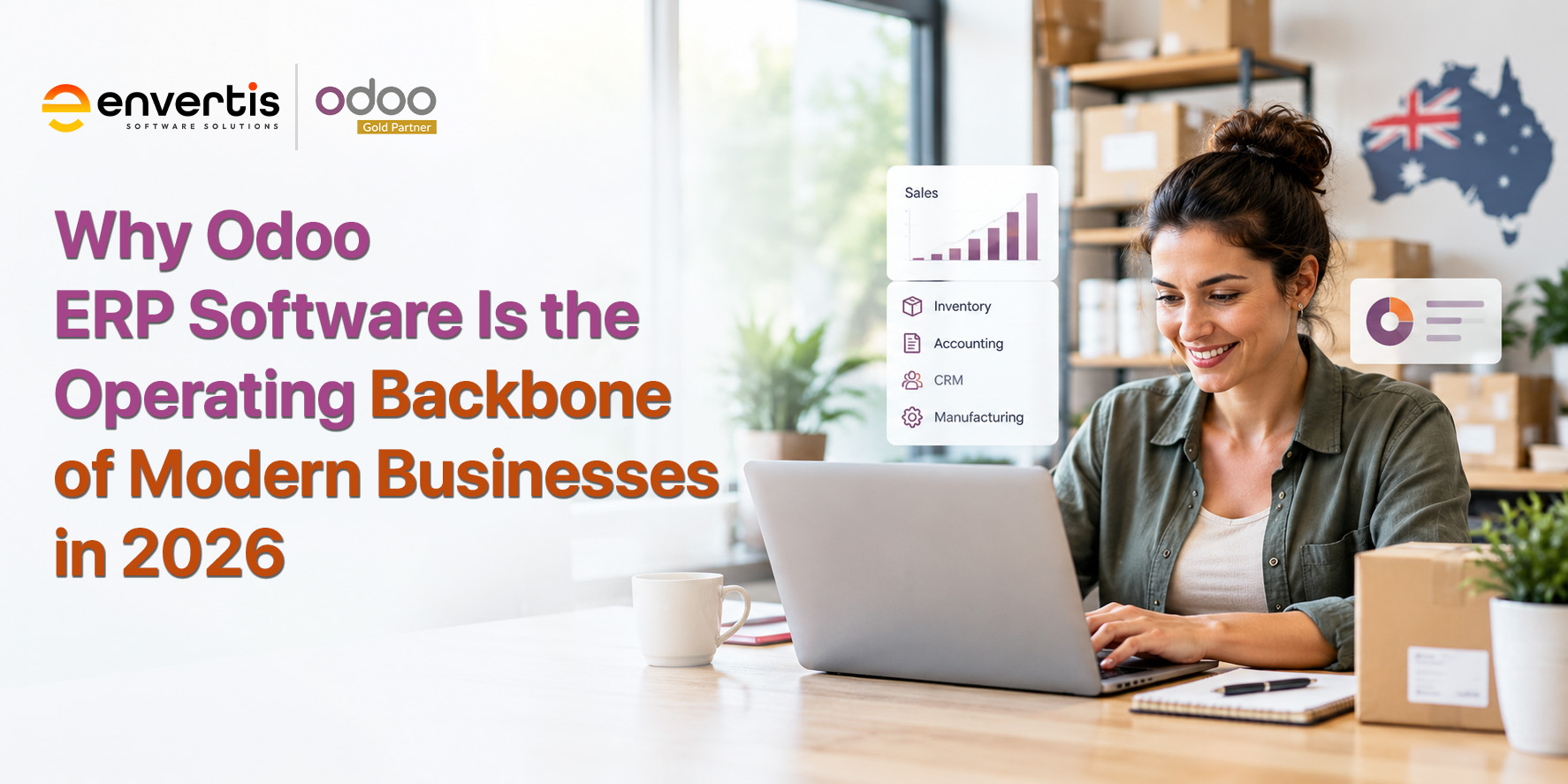
Business growth creates a familiar problem: more customers, more transactions, more employees, more data and more systems to manage. For a growing number of Australian companies, Odoo ERP software has become the answer, because it connects the whole operation instead of adding one more tool to the pile.
The challenge is widespread.
The Australian Bureau of Statistics counted 2,729,648 actively trading businesses as of 30 June 2025, and 97.3% were small businesses with fewer than 20 employees.
Many of these businesses still run on spreadsheets, a standalone accounting package and a separate CRM.
That setup works for a while. Then data gets duplicated, approvals slow down, and nobody fully trusts the monthly report. This is why ERP has moved from a back-office tool to the digital foundation of the business.
So what has changed in 2026, and why does it matter for Australian businesses right now?
The question is no longer whether a business needs software for accounts, stock or sales. The real question is whether its technology can connect operations, automate repetitive work and give leaders reliable numbers for faster decisions.
ERP in 2026: From Business Software to an Operating Platform
An ERP system brings together accounting, CRM, sales, purchasing, inventory, manufacturing, eCommerce and projects into a single environment. Instead of each department having its own system, information flows between functions through shared records and established workflows.
What has changed is the scale. Today’s cloud ERP combines integrated data, automation, analytics and AI.
Gartner describes AI-powered ERP as moving traditional systems of record towards real-time intelligence, automation and action. For a growing business, that means ERP is no longer just where transactions are stored. It is where the business actually runs.
Australian Businesses Are Investing Heavily in Cloud and Software
The Australian market shows how quickly this shift is happening:
- Software-as-a-service remains the largest cloud category in Australia, forecast to reach almost A$16.4 billion in 2026.
- Software is now the largest IT spending category in the country, and Gartner expects Australian software spending to exceed A$68 billion in 2027, up 13.3% on 2026.
The wider ERP market points the same way.
ERP Research’s 2026 analysis of 61 ERP systems found that 89% offer cloud deployment and 42% are cloud-only. It also found that 21% of published implementation case studies involved businesses replacing spreadsheets rather than another ERP.
That last figure matters for Australian SMEs. Most are not swapping one legacy ERP for another. They are moving from spreadsheets and disconnected apps to one integrated cloud platform that can grow with them.
AI Is Changing What Australian Businesses Expect From ERP
Traditional ERP automation is based on rules. It creates an invoice, updates stock or starts a purchase order. AI-powered ERP extends to analysis, forecasting, recommendations, and more complex workflows.
Australian SMEs are already moving in this direction.
According to the National AI Centre, SME AI adoption reached 44% in February 2026, and broad adoption, where AI is used across several parts of the business, hit its highest level in seven months.
The same research also shows the gaps.
Around 65% of non-adopting SMEs cited distrust of AI decisions or a preference to keep human control, and 19% said they simply do not know how to use AI in their business.
Globally, Gartner forecasts that 62% of cloud ERP spending could go to AI-enabled solutions by 2027, compared with 14% in 2024. It also predicts that organisations using cloud ERP with embedded AI assistants could achieve a 30% faster financial close by 2028.
This does not mean every business needs autonomous AI tomorrow. It means the ERP you select in 2026 should provide clean, connected data that AI can work with, and clear approval steps so people remain in control.
Why Businesses Outgrow Disconnected Software
A business can collect apps without becoming more efficient. One system manages leads, another handles accounting, a spreadsheet tracks stock and the team talks through email and chat. Management then waits for someone to pull it all into a report.
The individual tools are rarely the problem. The lack of connection between them is. When a customer places a single order, it can affect:
- Sales and customer records
- Inventory availability
- Purchasing requirements
- Warehouse operations
- Delivery planning
- Invoicing
- Financial reporting
With disconnected systems, staff move this information by hand. With integrated ERP, one order updates every step through defined workflows.
A Single Source of Business Data
Reliable decisions depend on reliable information. When departments keep separate records, managers end up with conflicting numbers for sales, stock and cash.
An integrated ERP gives every authorised user the same data. Sales sees customer and order history. The warehouse sees live stock movements. Finance works from actual transactions. Management reports from one source. The value is not more data. It is connected data that makes sense in the context of the whole business.
Automation That Cuts Repetitive Admin
Manual labour takes time away from customers, planning and growth. Typical examples include data re-entry, repeating documents, matching transactions, chasing approvals, checking stock levels and building routine reports.
ERP automation takes much of this off the plate, which matters as Australian businesses look to improve productivity without increasing administrative headcount.

Still juggling spreadsheets and disconnected apps?
Get a free Odoo process reviewERP Implementation Should Begin With Process Design
One of the biggest mistakes businesses can make is treating ERP implementation as a software installation project.
Successful implementation requires understanding how the organisation operates.
Before configuring an ERP, businesses should examine questions such as:
- Which processes are currently manual?
- Where does duplicate data entry occur?
- Which approvals cause delays?
- Which departments depend on information from another team?
- Which spreadsheets are business-critical?
- Where do reporting gaps exist?
- Which processes should be automated and which workflows need to remain flexible?
This process-first approach helps ensure the ERP supports actual business requirements rather than forcing employees to adapt unnecessarily to an unsuitable configuration.
ERP Strengthens Financial Control
Financial management becomes more complex as businesses grow.
More customers, suppliers, transactions, locations, currencies and business entities can create additional administrative requirements.
An integrated ERP can connect financial information with operational activities such as sales, purchasing, inventory and expenses.
This gives finance teams more timely information while reducing reliance on manually consolidated data.
The trend towards AI-enabled finance makes this even more relevant. Gartner identifies intelligent process automation, adaptive analytics, and AI-driven planning and forecasting as emerging themes shaping cloud ERP finance applications in 2026.
Scale Without Multiplying Complexity
Growth should be driven by revenue, not administration. This is where a modular ERP really comes into its own. A business might begin with CRM, sales, and accounting, then add inventory, purchasing, manufacturing, eCommerce, or project management as it grows.
Odoo is built upon this model. It has over 28 million users, 21,000+ partners, about 50 core apps and over 50,000 community apps. Each app uses the same database, so a new module plugs into existing data rather than creating another island.
Real-Time Access Across Every Location
Australian businesses often span offices, warehouses, retail sites and remote teams, sometimes in different states and time zones. Staff need to check an order, update stock or approve a purchase without being in head office.
Cloud ERP provides secure access to authorised users from supported devices and locations. For companies with multiple warehouses or branches, this provides a single view of operations and reduces reliance on locally held records.
ERP Security and Governance Are Becoming Strategic Issues
Centralising business data increases the stakes on security.
The Australian Signals Directorate received more than 84,700 cybercrime reports in FY2024–25, roughly one every six minutes. The average self-reported cost per report was AUD 56,600 for small businesses, up 14%, and AUD 97,200 for medium businesses, up 55%.
A well-configured ERP helps manage this risk with role-based access, permissions, audit trails and central administration. These controls specify who can see or alter sensitive information, which becomes even more critical as AI begins to operate within business workflows. According to Gartner, emerging themes for cloud ERP finance applications include AI trust, risk and security management.
ERP Supports Faster, Data-Driven Decisions
When operations and reporting live in one system, managers stop waiting for departmental spreadsheets. They can see sales performance, stock levels, purchasing needs, cash flow, production output, operating costs and resource use from a central source.
Modern platforms are moving beyond storing this data. They increasingly interpret it, surface insights and automate parts of the decision. That makes data quality and system integration more important than ever.
Why Odoo ERP Software Fits the 2026 Australian Landscape
If you are running a business and want an all-in-one, flexible platform, Odoo ERP software has you covered. It covers CRM, accounting, inventory, sales, eCommerce, purchasing, manufacturing, project management, HR, and more. The Australian accounting localisation makes life easier with built-in GST and BAS reporting. You get local compliance sorted right alongside your daily operations.
The best thing is Odoo’s modular setup. It means you can start small and add more features as you need them. That is perfect for Australian SMEs looking to upgrade without handing over a fortune for the full ERP package upfront. You modernise at your own pace and pay only for what you use.
Build an ERP Foundation That Can Grow With Your Business
ERP in 2026 is not just about ditching paperwork or managing accounts and inventory in a single app. It is about creating an interconnected foundation that brings automation, real-time insights, secure cloud access, and sets businesses up for AI-driven operations.
If you are considering Odoo ERP software, do not get sidetracked by just looking at the list of apps. The real benefit is figuring out how your business actually runs, mapping out the right workflows, integrating your essential systems, and tailoring the platform to hit goals you can really measure.
This is where Envertis comes in. Founded in 2006, Envertis became an Odoo partner in 2017, was recognised as an Odoo Centre of Excellence in 2018 and became an Odoo Gold Partner in 2024. With more than 80 successful Odoo implementations and offices in Sydney, Melbourne, Brisbane, Adelaide and Perth, our functional and technical team helps Australian businesses implement, customise and integrate Odoo around how they actually work.
Ready to make Odoo the backbone of your business?
Talk to an Odoo expertFrequently Asked Questions
1. What makes Odoo different from other ERP software?
Odoo is modular. You start with the apps you need, such as CRM, accounting or inventory, and add more as you grow. Every app shares one database, so sales, finance and operations all work from the same information without manual double entry.
2. Why are more businesses choosing Odoo as their core system in 2026?
Businesses want fewer disconnected tools and faster decisions. Odoo replaces separate spreadsheets and standalone apps with one connected platform. Regular updates, flexible pricing, Australian accounting localisation and growing AI features make it practical for companies that want to scale without rebuilding their systems every few years.
3. Is Odoo suitable for small and medium-sized businesses?
Yes. Odoo is built to suit SMEs as well as larger organisations. A small business can start with a few core apps and keep costs manageable, then add new modules as it grows instead of migrating to a different platform.
4. Which business functions can Odoo manage?
Odoo covers sales, CRM, accounting, inventory, purchasing, manufacturing, project management, HR, eCommerce and marketing. Because these functions connect, a single sales order can update stock levels, trigger an invoice and feed financial reports automatically.
5. How long does an Odoo implementation usually take?
Timelines depend on business size, the number of modules and how much customisation you need. A simple setup may take a few weeks, while a complex multi-department rollout can take several months. Clean data, clear goals and a phased plan help keep the project on track.
6. Do I need an Odoo partner to implement the system?
You can set up basic apps yourself, but most growing businesses benefit from an experienced partner. A certified Odoo Gold partner like Envertis can map your processes, migrate data, build custom features, and train your team, reducing risk and delivering value sooner.
