
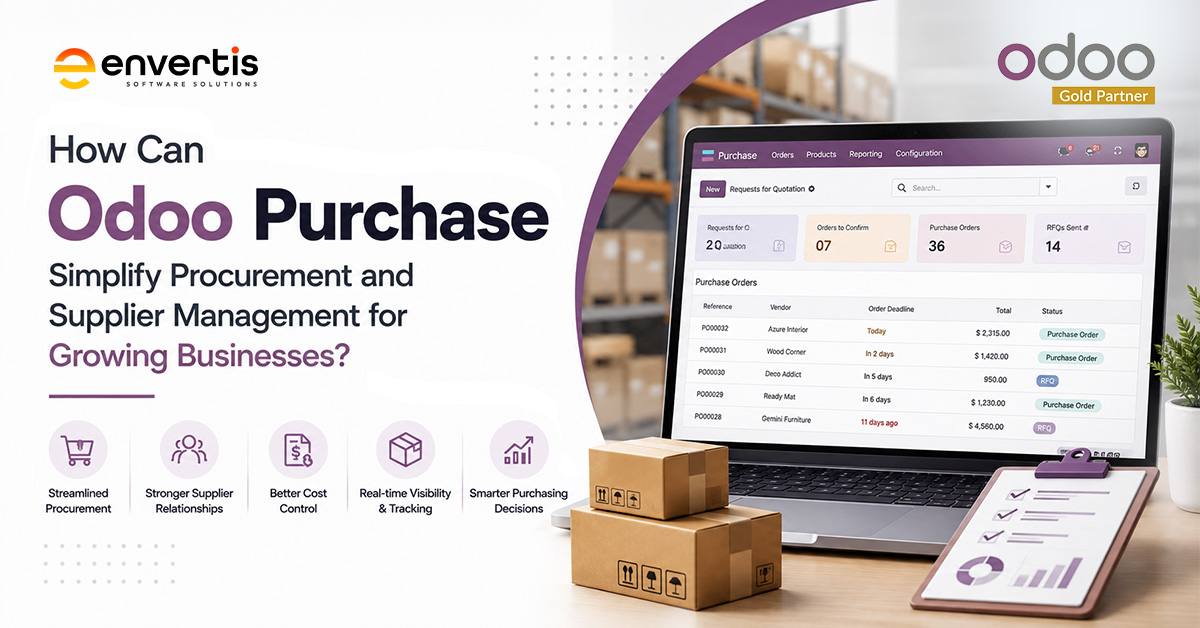
Picture a Tuesday morning at a growing wholesale business in Melbourne.
A key supplier has missed a delivery. The purchasing officer cannot find the original purchase order because it lives in a colleague’s inbox. The warehouse team is chasing stock that finance thought was already paid for.
Three spreadsheets tell three different stories.
This is the daily reality for many Australian wholesalers and exporters. As order volumes grow, manual procurement stops scaling. Errors creep in. Margins leak.
Odoo purchase offers a way out. It is the procurement module inside the Odoo ERP platform, built to bring purchase orders, suppliers and approvals into one connected system. For businesses outgrowing legacy tools, strong Odoo purchase management turns a chaotic process into a predictable one.
This blog explains how it works, where it saves money, and what to weigh before you commit.
Why Procurement Complexity Holds Back Australian Wholesalers
Wholesale and export businesses in Australia manage high volumes of purchase orders across multiple suppliers, often with complex lead times, currency considerations, and compliance requirements such as GST and TPAR reporting.
Most wholesalers do not decide to fix procurement. A bad week decides for them. However, the warning indices show up long before an emergency arises.
Several issues arise when procurement is housed in spreadsheets, email inboxes, or unorganised traditional tools:
- Manual RFQ processes that delay supplier selection and inflate cycle times
- No central vendor database, leading to inconsistent terms and missed volume discounts
- Poor inventory alignment, causing stockouts or overstocking
- Fragmented approval workflows that create bottlenecks and audit risks
- Limited spend visibility, making it hard to negotiate better terms or identify maverick spending
Watch for these patterns. No one knows whose turn it is, so approvals stagnate in inboxes for days. Because reordering is based on historical data rather than rules, stockouts and overstocks usually occur within a given month. Suppliers quote different prices for the same item, and no one catches it. Finance and the warehouse disagree on what was received and what was actually paid.
Suppose two or more of these sound familiar; manual tools have reached their limit. This is the point where Odoo purchase management software stops being a nice-to-have and starts paying for itself.

What Is Odoo Purchase Management Software?
Odoo purchase management is the procurement module within the Odoo ERP suite. It centralises every step of the procure-to-pay cycle, from Requests for Quotation (RFQs) through purchase orders, goods receipt, three-way matching, and vendor bill posting to accounting.
Unlike standalone purchasing tools, Odoo purchasing software integrates natively with Inventory, Accounting, Sales, and Manufacturing modules, ensuring data flows seamlessly across departments.
For Australian wholesalers, this means:
- Unified vendor records with banking details, payment terms, tax registrations, and contract terms
- Automated PO generation based on reorder rules, MRP runs, or approved requisitions
- Real-time inventory updates when goods are received against purchase orders
- GST and TPAR compliance built into vendor bills and reporting
- Peppol-capable e-invoicing for suppliers who support it
The outcome is a single source of truth for procurement activity, with full audit trails and actionable insights into supplier performance and spend patterns.
What Odoo Purchase Management Actually Does
Odoo Purchase is the procurement engine inside Odoo ERP. It connects buying to inventory, accounting and sales, so one action updates the whole system.
Here is what strong Odoo purchase management software brings together:
- Purchase orders in one place.
Create, send and track every order from a single screen. Odoo purchase order management removes the version-control chaos of shared spreadsheets.
- Requests for quotation.
Send the same request to several suppliers, then compare prices side by side before you commit.
- Automated reordering.
Set minimum stock rules, and Odoo procurement automation raises purchase orders when levels run low. No more emergency buys at premium prices.
- Supplier price lists.
Store agreed prices and lead times against each vendor, so the right cost applies every time.
- Three-way matching.
Odoo checks the purchase order, the goods received and the supplier bill before payment. Mismatches get flagged and are not paid.
- Live reporting.
See spend by supplier, category and period without building a report by hand.
Each feature is useful alone. Together, they turn procurement into a controlled, measurable process. That is the core promise of Odoo procurement management: less firefighting, more foresight.

How Odoo Purchase Management Simplifies Procurement for Growing Businesses
Good procurement is not about buying less. It is about buying with intent. The table below shows the shift in plain terms.
| Everyday task | Spreadsheets and email | With Odoo Purchase |
| Placing an order | Retyped by hand | Created from a request in clicks |
| Getting approvals | Chased through inboxes | Routed automatically by value |
| Supplier details | Scattered across files | Held in one shared record |
| Matching invoices | Checked line by line | Compared to the order automatically |
| Reordering stock | Reactive and late | Triggered by set rules |
Your procurement team spends hours chasing quotes, reconciling spreadsheets, and waiting for approvals while stock levels dip and suppliers miss delivery windows.
Why Australian Wholesalers Are Making the Switch
The shift to digital procurement is not a passing trend. It is a proven advantage. In short, the businesses that modernise their buying win on cost. Australian wholesalers and exporters face particular pressure.
Freight costs shift. Supplier lead times vary. Currency moves affect landed cost. A modern Odoo purchase management software setup helps you respond quickly to all of it.

Consider a distributor that moves from spreadsheets to a structured system. Reorder points now trigger automatically. Preferred suppliers receive quote requests in seconds.
Finance matches every invoice against its order before payment. The result is fewer stockouts, tighter margins, and hours returned to the team each week. A well-configured Odoo purchase setup makes this the new normal, not the exception.
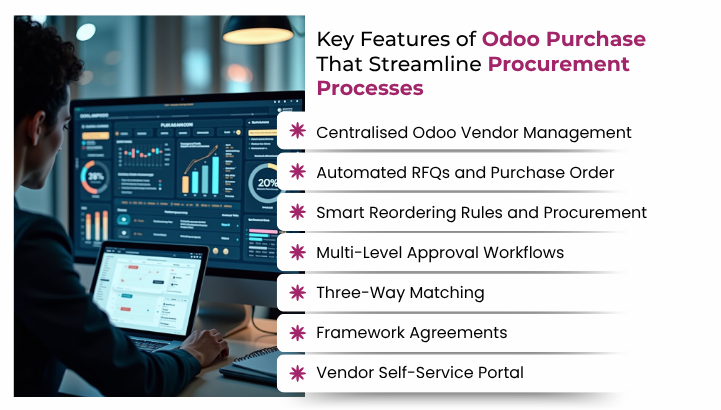
Key Features of Odoo Purchase That Streamline Procurement Processes
One of the strongest advantages of Odoo procurement software is its native integration across the ERP suite.
When a purchase order is confirmed in Odoo Purchase, the system creates:
- Centralised Odoo Vendor Management and Performance Tracking
Odoo supplier management software maintains a complete vendor database with commercial terms, price lists, lead times, and performance ratings per order (onon-timeelivery, quality, price). Procurement teams can compare suppliers side by side, enforce preferred vendor policies, and negotiate from a data-driven position.
- Automated RFQs and Purchase Order Creation
Users can generate requests for quotation to multiple suppliers simultaneously, compare offers, and convert the best quote to a purchase order with one click. Odoo purchase email orders directly to suppliers and tracks supplier confirmations for each order. Structured RFQ processes and supplier price comparison consistently deliver better terms and reduce maverick spending.
- Smart Reordering Rules and Procurement Automation
Odoo procurement automation uses reorder rules, minimum and maximum stock levels, and MRP integration to trigger automatic Odoo purchase orders when inventory falls below thresholds. This just-in-time approach prevents stockouts while avoiding excess inventory carrying costs.
- Multi-Level Approval Workflows
Businesses can configure approval workflows based on order value, category, or user role, ensuring accountability and transparency without creating bottlenecks. Digital approvals cut days out of the average procurement cycle.
- Three-Way Matching and Landed Cost Allocation
Odoo purchase management software automatically matches purchase orders, goods receipts, and vendor bills and flags discrepancies for review. Landed costs such as freight, duties, and insurance can be allocated to product costs, giving accurate margin calculations for wholesale and export transactions.
- Blanket Orders and Framework Agreements
For recurring raw materials, services, or MRO items, Odoo purchasing automation supports blanket purchase orders with periodic releases under long-term contracts. This simplifies procurement for high-volume, repeat purchases.
- Vendor Self Service Portal
Suppliers can confirm purchase orders, send advance shipping notices, submit invoices, and view payment status through a vendor portal, reducing inbound queries and improving collaboration.
This eliminates data silos and ensures that procurement decisions reflect real-time demand, cash flow, and production schedules. For wholesalers managing multi-warehouse operations or B2B pricing tiers, this integration is critical for maintaining accuracy and speed.
How Odoo Purchase Connects the Entire Buying Cycle
Odoo Purchase’s real strength isn’t any single feature. It connects procurement to every other aspect of the enterprise. Odoo automatically adjusts inventory when it receives a purchase order.
Once the goods arrive, the stock count updates and the supplier bill becomes available for approval. Once you approve the bill, the accounting department records it without re-entering any data.

Sales teams can track incoming stock in real time and give customers the expected delivery date without guesswork. Since an independent spreadsheet or add-on tool can never provide this, all modules refer to the same information.
Any change in one module is reflected in all others. For a growing exporter, a single database makes data reconciliation unnecessary and saves many staff hours. Good Odoo procurement software does not just speed up buying. It makes the whole business easier to run and easier to trust.
Measurable Benefits for Growing Wholesale Businesses
Australian wholesalers that implement Odoo purchase management typically see:
- 40 to 60 per cent reduction in purchase cycle times through automated PO generation and digital approvals
- 15 to 25 per cent cost savings from better vendor negotiation, compliance enforcement, and reduced maverick spending
- Faster order processing and improved inventory control through smart reordering rules
- Streamlined financial management with three-way matching and automated GST/TPAR reporting
- Improved supplier relationships via vendor portals and performance tracking
These gains compound as businesses scale. A wholesaler processing 500 purchase orders per month can save hundreds of hours annually while reducing procurement costs by tens of thousands of dollars.

Envertis: The Future of Procurement Automation
A powerful tool still needs a considered setup. Approval rules, supplier data and reorder points must match how your business actually buys. Configured poorly, even the best procurement system frustrates the team it should help. This is where an experienced partner earns its keep. The team maps your current process first, then builds an Odoo supplier management system and purchasing workflow around it.
Envertis works with wholesalers and exporters across Sydney, Melbourne, Brisbane, Adelaide and Perth. That local knowledge matters, because a system built around Australian tax, freight and supplier realities beats a generic template every time. Getting the foundations right early saves a painful rebuild later, and it keeps your Odoo purchase order management clean as volumes climb.

Frequently Asked Question: Odoo Purchase for Australian Wholesalers
- What is Odoo Purchase used for?
Odoo Purchase manages the entire procure-to-pay cycle, including RFQs, purchase orders, supplier management, goods receipt, three-way matching, and posting vendor bills to accounting. It integrates with Inventory, Accounting, and Sales for end-to-end visibility.
- How does Odoo Purchase automate procurement?
Odoo procurement automation uses reorder rules, MRP integration, and approval workflows to automatically trigger purchase orders, streamline RFQs, and enforce compliance without manual intervention.
- Can Odoo handle Australian GST and TPAR requirements?
Yes. Odoo purchasing software includes Australian localisation for GST, TPAR reporting, and Peppol e-invoicing, ensuring vendor bills and procurement reports meet compliance standards.
- Is Odoo Purchase suitable for mid-market wholesale businesses?
Absolutely. Odoo Purchase management scales with growing wholesalers, supporting multi-warehouse operations, blanket orders, vendor portals, and advanced reporting for strategic procurement decisions.
