
Ask a room of small business owners what they think of ERP, and many picture the same thing: a huge, costly system built for corporations with their own IT departments.
That picture is out of date.
Odoo ERP for SMEs has changed what a small or mid-sized business can expect from a single connected platform, and the companies that gain the most are rarely the largest ones.
If you run a growing company in Australia, the real question is no longer whether you can afford an ERP. It is how much longer you can afford to run the business across a dozen disconnected spreadsheets and apps.
Where The “Odoo Is Only For Big Companies” Myth Comes From
A decade back, people used to think ERP was only for big companies, and honestly, that made sense. The traditional systems were pricey and took years to set up. Also, you needed a whole IT crew just to keep them working.
But then Odoo came along and changed the game. Instead of one giant package, it is built as a flexible, open-source system where you pay for just what you need.
You can start small, maybe just a couple of apps, and add mre as you grow. That approach makes ERP for small business practical, affordable, and quick to deploy.
The numbers back this up.

Being small is simply no longer a reason to sit on the sidelines.
Why Odoo Is The Best Fit For Small Businesses
Lots of ERP tools say they can handle a small business, but Odoo just fits better for most SMEs, and you notice it right away.
Here is why:
- The interface feels familiar, so people get up to speed in days instead of dragging through weeks of training. That saves time and keeps onboarding costs low.
- Odoo has a massive app ecosystem. Whatever quirky or niche thing your business does, there’s probably already a module for it.
- Updates roll out regularly, and the community actually stays active, which means you get a platform that keeps getting better, not stale.
- And you get to choose: host everything yourself or use the cloud. That puts your data and your budget right where you want it- under your control.
For a small, nimble team, that mix of simplicity, flexibility, and control is tough to beat. It’s the biggest reason Odoo lands on so many small business shortlists, and why, once owners try it, they stop bouncing between disconnected tools.
The Benefits Of Odoo ERP For SMEs
Here is what small and mid-sized businesses gain once their tools stop working in isolation.
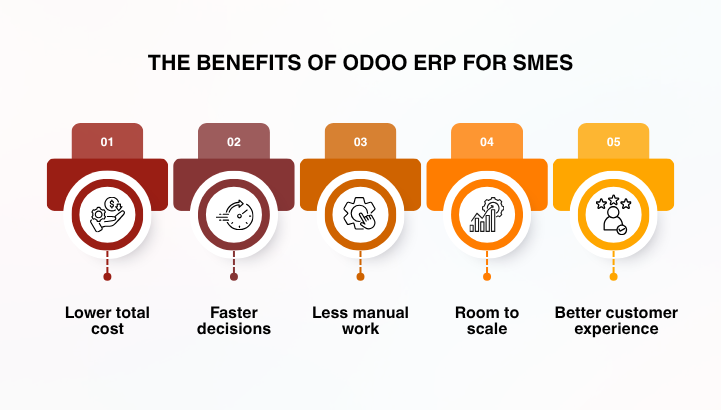
- Lower total cost: Replacing several paid subscriptions with one platform makes Odoo an affordable ERP software choice, not a luxury.
- Faster decisions: Live dashboards show cash flow, stock, and sales in real time, so you act on facts rather than last month’s guesswork.
- Less manual work: Business process automation and workflow automation handle repetitive tasks such as invoicing, reminders, and stock updates.
- Room to scale: Add users and modules as you grow, without a painful migration to a new system.
- Better customer experience: A shared view of every customer means quicker quotes, fewer errors, and smoother service.
Taken together, these gains are why so many owners now treat Odoo ERP software as a core part of their digital transformation rather than a nice-to-have.
Why SMEs Win The Most With Odoo ERP For SMEs
Big companies get ERP systems to wrestle with the complexity they’ve already got.
Smaller businesses turn to ERP so things never get out of hand in the first place. And honestly, that’s why small and midsize companies often see a bigger payoff.
- You only pay for what you actually need.
With Odoo, you pick and pay for just the apps you use; not a bloated suite. So whether you’re running a five-person service outfit or a fifty-person factory, you get the same platform without the eye-watering price tag. That’s what makes Odoo for small business genuinely accessible.
- It grows when you do.
Start with just CRM and accounting. As you expand, add inventory, manufacturing, or eCommerce- no painful system switch. That’s why so many business owners say Odoo ERP for growing businesses is an investment that just keeps paying back as you scale up.
- Everything in one place.
When your sales, inventory, and finance pull from the same data, your team stops wasting time retyping info or sorting out conflicting versions. That unified database is what makes everything run smoothly. Small businesses feel the difference right away.

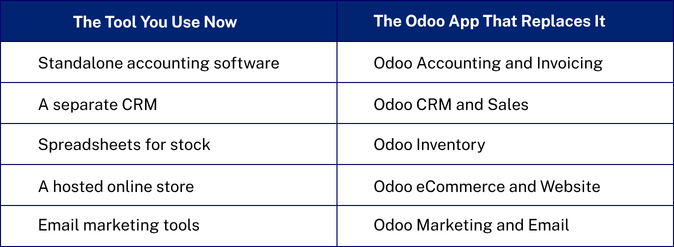
Can Odoo Replace Your Other Business Apps?
Most SMEs run separate tools for accounting, marketing, stock, and sales. Odoo brings these into one business management software platform, which cuts subscription costs and removes the gaps where data goes missing.

How Much Does Odoo Cost For SMEs?
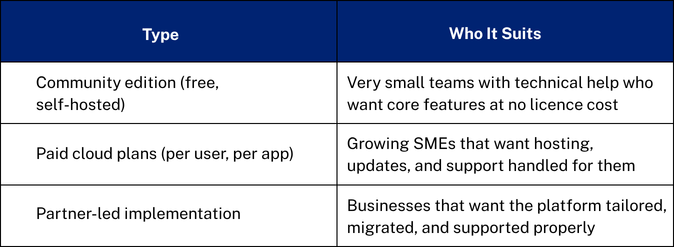
Odoo’s pricing beats most older systems on flexibility. The license is usually the cheap part. Most of your spend goes into setup, moving your data, and any tweaks or customisation you want.
The good thing? You only pay for what you need as you grow. Start small: add users and modules later, once you see the value. Always ask your Odoo partner for a staged quote upfront. That way, you’ll know exactly what each phase costs before you commit.

What Australian SMEs Should Look For In An Odoo Partner?
Australian SMEs have their own requirements: GST and BAS handling, Single Touch Payroll, support during local hours, and clean links to local banks and carriers. A generic offshore setup often misses this detail, which is why a local Odoo implementation Australia partner matters.
When you choose an Odoo ERP Australia partner, look for the following:
- Proven local implementations across businesses of your size and industry.
- Australian compliance knowledge, including tax, payroll, and reporting rules.
- Support in your timezone, so help arrives when you actually need it.
- Clear, staged pricing with no surprises after go-live.
- Practical training that gets your team confident quickly.
Handled this way, Odoo becomes an affordable ERP software choice for Australian SMEs that still meets every local obligation.

A Simple Way To Start With Odoo
You don’t have to overhaul everything in one shot. The most successful SME rollouts happen in stages, so you keep risk low and start seeing results early.
- Tackle the biggest pain point; maybe it’s accounting or sales. Move that onto Odoo and show real value fast.
- Add the module connected to it. If you started with accounting, pull in inventory or CRM, so your data flows cleanly from one end to the other.
- Once things feel steady, bring in reporting, automation, or extra apps. Build on that solid foundation when your team’s ready.
Every step delivers its own payoff. The business starts working better right away, instead of waiting forever for an all-at-once launch that might never happen.
Getting Your Odoo Implementation Right
Software doesn’t just fall apart on its own. Projects hit trouble when people keep adding features, the data’s a mess, or nobody brings the whole team onboard. It’s better to start with a clean, simple first phase than to go all-in and get stuck.
These days, everyone’s going cloud.

Also, most people don’t bother with heavy customisation. They stick with standard setups, and that’s working just fine for most small and midsize businesses.
That’s where a good local partner really matters. They help steer the project, handle the messy migration, and train your team so your Odoo ERP implementation actually launches on time.
Ready To See What Odoo Can Do For Your Business?
Odoo isn’t just for big companies. It’s actually one of the top ERP choices for small and medium businesses in Australia because it matches the way you work. When your software connects, you save time and money, and that means more room to grow.
Envertis, a certified Odoo Gold Partner founded in 2006, has completed more than 75 Odoo implementations and was recognised as an Odoo Centre of Excellence in 2018. That track record means your business gets a partner who has solved the same problems many times, not one learning on your budget.
If you’re curious, reach out to the Envertis team. We can help you roll out Odoo in stages, all tailored to your goals, your budget, and whatever compliance rules you have to follow. Book a chat today and find out how much easier running your business gets.

Frequently Asked Questions
Q. Is Odoo suitable for small businesses?
Yes. Odoo is one of the most popular ERP choices for small firms because you can start with a few apps and pay for only what you use. It suits teams from a handful of people upwards.
Q. Is Odoo only for large companies?
No. That’s just not true. This whole blog is here to bust that myth. Odoo isn’t just for big companies chasing growth. It actually works just as well when you’re a small business, and a lot of SMEs see results faster because complicated setups do not bog them down.
Q. Why do SMEs need an ERP system?
With an ERP, everything- sales, inventory, finances, customer info- lands in one spot. If you run a small or medium company, that means you spend a lot less time on manual tasks, make fewer mistakes, and finally get numbers you can trust. Doing the same with a bunch of disconnected tools is challenging.
Q. How much does Odoo cost for SMEs?
Costs depend on the edition, the number of users, and how much tailoring you need. There’s a free community version, but if you want cloud hosting and extra features, you have to pay per user and per app. For most SMEs, the real cost comes at implementation. Just make sure you get a staged quote, so there are no surprises.
Q. Can Odoo replace multiple business applications?
In most cases, yes. Odoo handles your accounting, CRM, inventory, eCommerce, and marketing, so you can finally drop those other subscriptions and run everything from a single platform.
