
Every plant manager knows the feeling. A key machine breaks down right in the middle of a shift. The whole production plan falls apart, and now the maintenance crew is scrambling for parts that’ll take days to show up.
What’s really annoying? Most breakdowns don’t come out of nowhere. The machines actually drop hints before they fail, but nobody pays attention.
That’s exactly where AI ERP for manufacturing steps in. By bringing together machine data, maintenance records, and production schedules into a single smart system, an AI-customised ERP spots trouble early.
Instead of waiting for something to go wrong, it detects warning signs and helps you fix issues before they become disasters.
In this article, you’ll see how this technology works, the results manufacturers are achieving, and why companies using customised ERP solutions such as Odoo continue to outperform generic, out-of-the-box options.
The Real Cost of Unplanned Downtime
A breakdown never sends you one tidy invoice. When a machine stops without warning, the damage spreads quietly through the whole operation:
- Emergency repair bills: After-hours call-outs, rushed diagnostics and premium labour rates cost far more than the same job done on a planned schedule.
- Expedited freight: Air-freighting a spare part from an overseas supplier can cost more than the part itself.
- Overtime blowouts: Maintenance crews and operators stay on to claw back production hours, and the wage bill climbs with every shift.
- Missed delivery windows: Late orders trigger penalty clauses, forced discounts and awkward phone calls to your best customers.
- Eroded customer trust: One missed deadline gets forgiven. A pattern of them sends buyers looking for a more reliable supplier.
The numbers back up what plant managers feel in their gut.
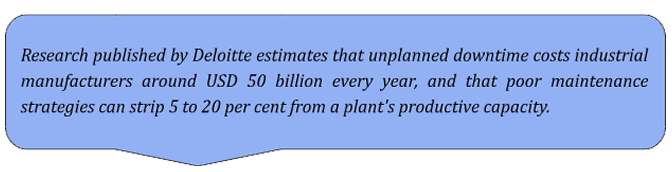
For Australian manufacturers, those figures hit harder than most. Lean teams, tight margins and long supplier lead times mean a single failed gearbox on an imported line can idle production for weeks. In this environment, machine failure prediction is not a nice-to-have. It is a competitive necessity.
The frustrating part is that neither of the traditional maintenance strategies solves the problem:
- Reactive maintenance waits for the breakdown. You get maximum damage, maximum disruption and zero say over the timing.
- Preventive maintenance follows the calendar. You spend labour and parts on healthy machines, yet still miss the faults that develop between scheduled services.
- AI predictive maintenance, delivered through a predictive maintenance ERP, follows the machine itself. Each asset gets serviced exactly when its condition demands it, and not a day sooner.
What Is AI ERP for Manufacturing?
An AI-powered ERP isn’t just another enterprise resource planning system; it actually thinks ahead. It uses machine learning and predictive analytics to make sense of real-time data. Instead of only tracking past events, it looks at what’s going on now, spots trends, figures out what’s likely to happen next, and recommends or triggers the right response.

Standard manufacturing ERP software already collects a ton of info: work orders, maintenance logs, spare parts stock, supplier lead times, production schedules, and machine records. But before AI, these systems just stored all that data and didn’t really learn from it.
That’s where AI takes over. If you plug in your machine sensors and sync up your shop floor, the ERP doesn’t just get a snapshot; it starts getting a live feed of how everything’s running.
Machine learning models then scan that streaming data, compare it to historical failure patterns, and determine each asset’s health and how much life it has left. That’s the real heart of a predictive maintenance ERP.
From Record Keeper to Early Warning System
Think of the difference this way. A conventional ERP tells you that pump three failed last Tuesday and cost you eleven hours of production.
An AI ERP for manufacturing tells you on Monday that pump three is showing a vibration signature consistent with bearing wear and will likely fail within two weeks. Also, the replacement bearing is not in stock, and Thursday night is the lowest-impact window for scheduling the repair.
One system reports history. The other protects your production plan.
How AI ERP Predicts Machine Failures
Strip away the jargon and the answer to how AI ERP predicts machine failures is a simple three-step loop: the system senses what your machines are doing, learns what trouble looks like, and acts before the trouble arrives. Each step runs within a single AI-powered ERP platform, which is exactly why the loop works.
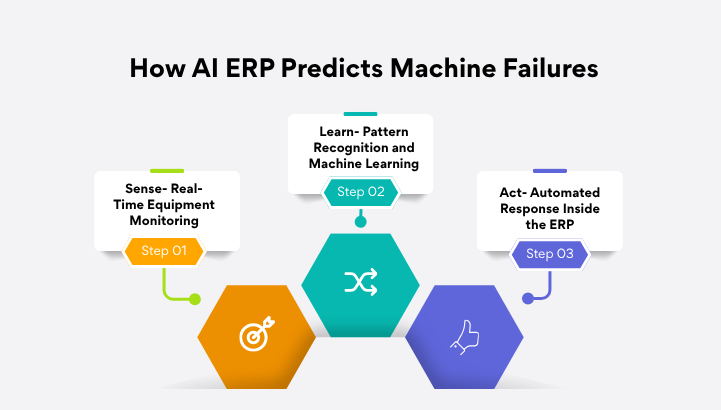
Step 1: Sense- Real-Time Equipment Monitoring
Your machines talk constantly. IoT sensors fitted to critical assets simply listen, capturing signals such as:
- Vibration and acoustic patterns that shift as bearings and gears wear.
- Temperature and pressure readings that creep upward under strain.
- Motor current and cycle counts that reveal how hard each asset is really working.
Real-time equipment monitoring streams these signals directly into the ERP, where they sit alongside the maintenance logs and production records for the same machines. Standalone monitoring tools cannot offer that single, unified view, and it is the backbone of the smart factory and Industry 4.0 model.
Step 2: Learn- Pattern Recognition and Machine Learning
Here is where the intelligence kicks in. Machine learning models build a baseline of what “healthy” looks like for every individual asset, then hunt for the small deviations that precede a breakdown.
- A bearing running two degrees warmer than last month.
- A vibration frequency that has drifted ever so slightly.
- A motor drawing a touch more current than usual.
Any one of these would slip past even your sharpest operator on a noisy shop floor. To a model performing machine health monitoring around the clock, they present an unmistakable warning.
Better still, the system never stops studying. Every new work order and every failure event feeds back into the models, so prediction accuracy sharpens month after month.
Step 3: Act- Automated Response Inside the ERP
A prediction that sits on a dashboard is just an expensive worry. This final step is where an AI ERP for manufacturing leaves standalone monitoring tools behind, because the ERP is where things actually get done.
The moment a failure is forecast, the platform can:
- Raise a maintenance work order with the fault details already attached.
- Reserve or purchase the spare parts the job will need.
- Check technician availability and slot the repair into their schedule.
- Reshuffle the production plan around the intervention with minimal disruption.
That is manufacturing automation doing what it does best: turning a warning signal into a completed, low-drama repair while your team stays focused on production.
The Measurable Benefits of AI-Powered Predictive Maintenance
The research on this is unusually consistent.
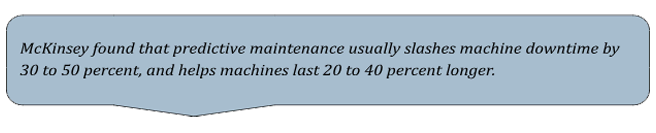
Percentages are useful for the boardroom, but plant managers live on the floor. Here is what those numbers actually look like in a working plant:
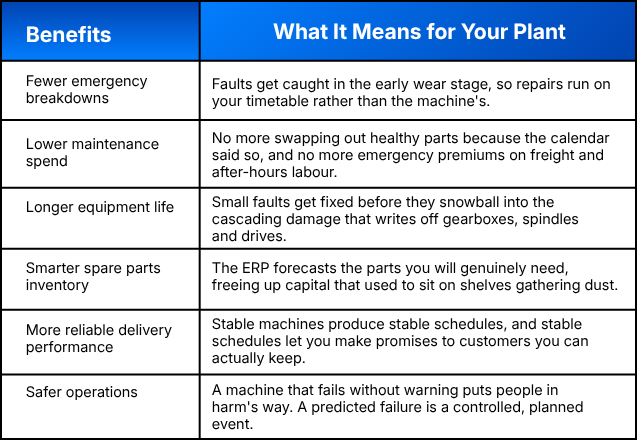
This is the everyday payoff of a well-configured predictive maintenance ERP.
Based on Envertis’ experience working with Australian manufacturers, we’ve seen organisations significantly improve equipment reliability and reduce costly unplanned downtime by embedding predictive maintenance capabilities into their ERP platforms.

Why Customised ERP Solutions Outperform Off-the-Shelf AI
Here is the part many vendors gloss over.
No two plants fail the same way.
A CNC shop, a bottling line, and a timber mill have different assets, failure modes, sensors, and maintenance workflows.
Customised ERP solutions matter because the predictive models, dashboards and automated responses must be built around your operation, not a hypothetical average factory. Generic manufacturing ERP software cannot anticipate that variety on its own.
Effective ERP customisation services for predictive maintenance typically involve:
- Mapping your critical assets and their known failure modes before any model is configured.
- Integrating your existing sensors, PLCs and SCADA systems with the ERP rather than forcing a hardware refresh.
- Cleaning and structuring historical maintenance data so the AI learns from accurate records.
- Tailoring alert thresholds and escalation rules to your team structure and shift patterns.
- Connecting predictions to your actual spare parts catalogue and supplier lead times.
This is why experienced AI ERP consulting partners insist on starting with a discovery phase. Custom ERP development grounded in your real failure history will always outperform a generic model switched on out of the box.
What This Looks Like in Odoo
Theory is nice. Let us talk about a real platform. Odoo has quietly become a favourite for manufacturing ERP with predictive analytics, and the reasons are practical rather than glamorous:
- A complete manufacturing suite covering production, maintenance, inventory, purchasing and quality in one system.
- An open, highly customisable architecture that bends to your plant instead of forcing your plant to bend to it.
- A price point built for SMEs and mid-market firms, not just enterprises with seven-figure IT budgets.
For many plants, that combination means retiring a patchwork of disconnected tools in favour of a single manufacturing ERP software platform that thinks as well as it records.
One Connected Loop, Not Five Separate Systems
Picture the flow inside a customised Odoo environment:
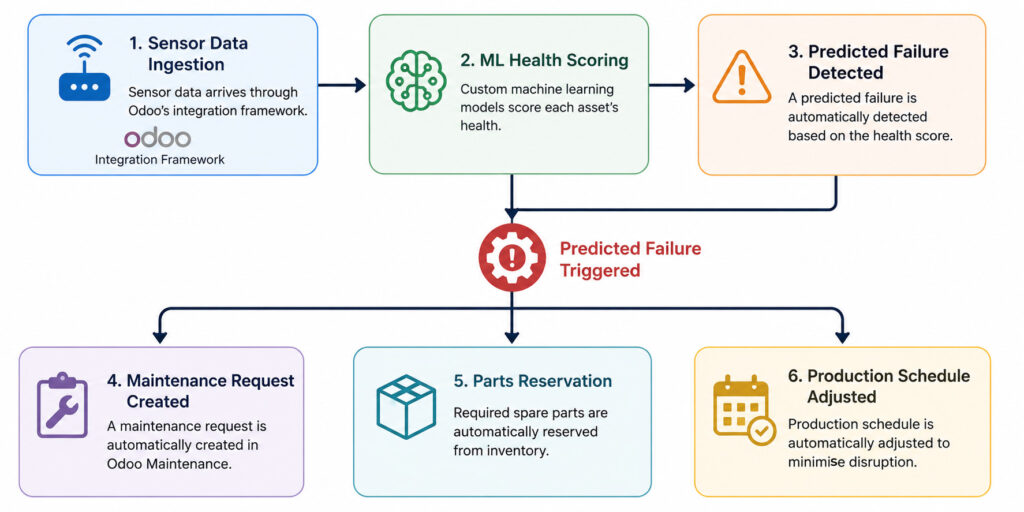
No emails between departments. The maintenance module already integrates with manufacturing, inventory, purchasing, and quality, so the entire response occurs in one place.
And because Odoo natively tracks mean time between failures and mean time to repair, you walk into your next leadership meeting armed with hard numbers, not anecdotes.
Start Small, Prove It, Then Scale
Odoo’s modularity means you never have to bet the whole plant on day one. The playbook most manufacturers follow looks like this:
- Pilot: Begin your AI ERP implementation on a handful of genuinely critical assets.
- Prove: Demonstrate the downtime reduction within one or two quarters.
- Expand: Roll machine health monitoring out across the site on the back of real results.
That staged path keeps risk low and gives you a business case that stands up when the capital expenditure committee starts asking pointed questions.
A Word of Honesty: Not Everything Deserves a Sensor
Here is something a good partner will tell you upfront: some low-value assets are genuinely cheaper to run to failure. Fitting predictive monitoring to a $400 pump makes no sense.
Part of an honest manufacturing ERP implementation is drawing that line clearly, so your investment lands where prediction pays and skips where it does not.
A Practical Roadmap for Plant Managers
You do not need to transform the whole plant at once. Digital transformation in manufacturing succeeds when it moves in deliberate steps:
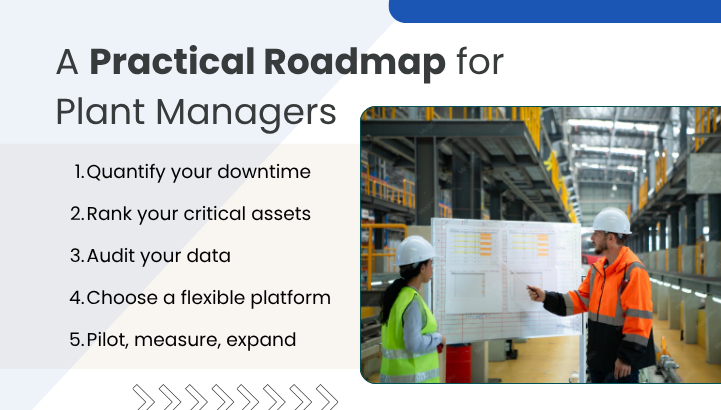
- Quantify your downtime. Track every unplanned stop for 60 to 90 days, including repair costs, lost output and expedite fees. This baseline becomes your business case.
- Rank your critical assets. Identify the machines whose failure hurts most, using downtime cost and repair lead time as your guide.
- Audit your data. Review maintenance logs and existing sensor coverage. Predictive analytics is only as good as the data behind it, so any gaps in that data shape your project plan.
- Choose a flexible platform. Select manufacturing ERP software that supports IoT integration and custom AI models, so the system adapts to your plant rather than the reverse.
- Pilot, measure, expand. Deploy on two or three critical assets, compare results against your baseline, then scale with confidence.
Manufacturers who follow this sequence typically see the pilot pay for itself through avoided breakdowns before the wider rollout even begins. Industrial AI solutions do not need to be a leap of faith when the rollout is measured at every step.
Turning Prediction into Protection with the Right Partner
Technology alone does not prevent breakdowns. The difference between a dashboard that gets ignored and a system that transforms plant reliability is implementation expertise: the ability to connect machines, data, people, and processes into a single workflow your team actually uses.
That is where a certified local partner earns its keep. Envertis is an Odoo Gold partner serving Australian manufacturers from offices in Sydney, Melbourne, Brisbane, Adelaide and Perth.
Since 2006, and with more than 200 Odoo implementations delivered, our consultants have helped SMEs and mid-market manufacturers design customised ERP solutions that fit how their plants really run, from initial asset assessment through to fully automated predictive-maintenance ERP workflows.
If unplanned downtime is costing your plant money, sleep or both, the fix is closer than you might think. Talk to the Envertis team about a tailored AI-powered manufacturing ERP software roadmap for your facility, and find out what your machines have been trying to tell you.

Frequently Asked Questions
Q. How does AI ERP predict machine failures?
An AI-powered ERP collects real-time data from sensors like vibration, temperature, and motor current. Then, machine learning checks those numbers against what’s normal for each machine. If the readings begin to follow a pattern that typically leads to failure, the system steps in. It flags the machine and creates a maintenance work order before anything actually breaks down.
Q. Is a predictive maintenance ERP worth it for small manufacturers?
Yes, when it is scoped sensibly. Most SMEs start with two or three critical assets, prove the downtime reduction within a quarter or two, and expand from there. Modular manufacturing ERP software like Odoo keeps the entry cost well within SME budgets.
Q. Do I need new machines to use AI predictive maintenance?
No. Retrofit IoT sensors work on most existing equipment, and customised ERP solutions can integrate the PLCs and monitoring hardware you already run. Your maintenance history is often the most valuable data you feed the system.
Q. How long does AI ERP implementation take?
A focused pilot on a few critical assets typically runs 8 to 12 weeks, including sensor integration and model training. Site-wide rollouts proceed in stages, so you see results long before the full project is complete.
