
Take a walk through any factory in Australia, and you’ll hear a familiar complaint from operations managers.
The job board says one thing, the warehouse insists on something else, and the finance team is juggling numbers that probably worked last week.
When these headaches start to stack up, most manufacturers hit a crossroads: Is it finally time for an Odoo implementation?
For many mid-sized Australian manufacturers, Odoo is the practical solution. It integrates sales, inventory, production, purchasing, and finance into a single system. The real challenge isn’t deciding whether you need an ERP; it’s recognising the moment your current setup starts costing you more than it saves.
Here are seven unmistakable signs your manufacturing business is ready for Odoo ERP. Treat this list like a checklist. If three or more of these strike a nerve, you’ve probably crossed the line where quick fixes just won’t cut it anymore.
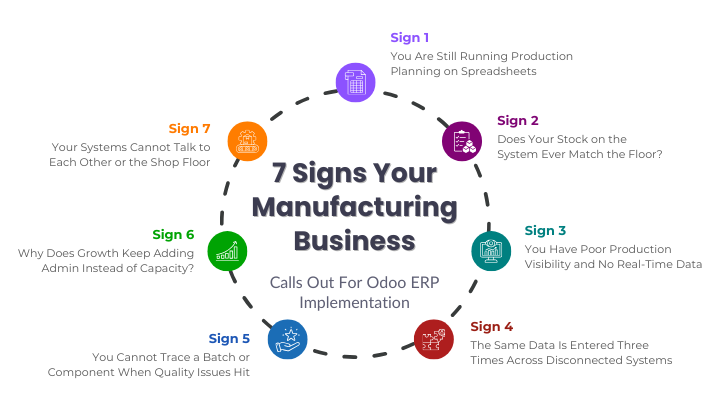
Sign 1: You Are Still Running Production Planning on Spreadsheets
Spreadsheets feel safe because everyone knows how to use them. The trouble starts the moment two people edit the same file, a formula breaks, or a planner goes on leave and takes the logic in their head with them.
Manual manufacturing processes like these do not scale and hide errors until they reach the floor.
Proper production planning software inside an ERP handles this differently. It links demand, capacity and material availability so the schedule updates itself when something changes.
Common warning signs include:
- Planners are rebuilding the same schedule every Monday from scratch
- Jobs starting before the right materials have arrived
- No single source of truth for what the floor should be doing today
With the Odoo Manufacturing Module, production scheduling becomes a live view rather than a static file, and the whole team works from the same plan.
Sign 2: Does Your Stock on the System Ever Match the Floor?
Inventory management challenges are the most common reason operations managers start looking at ERP.
You order materials you already have, or you promise a delivery date and then discover the components are missing. Either way, the cost lands on your reputation and your margin.
Good inventory management software tracks stock in real time as goods move in, out and between locations. It also warns you before you run short rather than after.
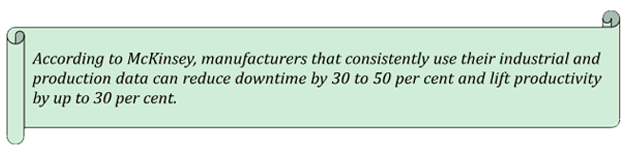
Most of this value comes from one thing: knowing what is actually happening in real time, rather than reacting to it later.
Sign 3: You Have Poor Production Visibility and No Real-Time Data
Poor production visibility is expensive in subtle ways.
You cannot see which jobs are running late until a customer chases you. You cannot see your true cost per unit until the month closes. You cannot spot a bottleneck until it has already slowed three other orders.
Real-time manufacturing data changes everything.
You get to see job status in real time, know exactly how busy each work centre is, and track actual costs as they come in. Then, analytics turn those numbers into clear choices you can act on now, not weeks or months from now.
- Can I see live job progress without interrupting the floor?
- Do I know my real margin on a job before it ships?
- Can I spot a delay early enough to do something about it?
If the honest answer is no, a manufacturing ERP system is the most direct way to get those answers back.
Sign 4: The Same Data Is Entered Three Times Across Disconnected Systems
Many Australian manufacturers run sales in one tool, accounts in another, and the floor on paper or a separate app. These disconnected business systems do not talk to each other, so people become the integration.
This is exactly the problem manufacturing workflow automation solves. When sales, inventory, production, and finance share a single database, a single entry flows through the entire process.
Manufacturing process automation also removes the small human errors that compound into wrong invoices and short shipments.
Sign 5: You Cannot Trace a Batch or Component When Quality Issues Hit
Traceability is not just paperwork for auditors. It is how you contain a problem before it spreads to customers. Without it, a single faulty component can force you to quarantine far more stock than necessary, simply because you cannot prove what went where.
An accurate Bill of Materials, or BOM, sits at the centre of this. Odoo ERP for manufacturing links every finished product to its components, suppliers and production lot. Strong quality control management then lets you trace forwards and backwards in seconds.
The benefits of Odoo ERP for manufacturers show up clearly here:
- Trace any batch to its exact components and supplier
- Quarantine only the stock that is genuinely affected
- Keep clean records for audits and compliance without manual effort
Sign 6: Why Does Growth Keep Adding Admin Instead of Capacity?
This is one of the clearest reasons to implement ERP software in manufacturing.
Healthy growth should add output, not paperwork. When it does the opposite, it usually means your processes only work because people are quietly holding them together.
Manufacturing ERP software removes that ceiling.
Automating purchase orders, stock replenishment and reporting means the same team can handle far more volume. Supply chain management software inside the same platform keeps suppliers and lead times in view, so scaling up does not turn into a scramble.
Knowing when to implement Odoo ERP in manufacturing often comes down to this single test: are you growing your output, or just your overheads?
Sign 7: Your Systems Cannot Talk to Each Other or the Shop Floor
The final sign is the one that ties the others together.
If your planning tools cannot see the floor, and your floor cannot see the plan, every handover relies on someone passing a message along. That gap is where production delays in manufacturing are born.
This is where understanding how Odoo ERP improves manufacturing efficiency matters.
One connected platform means an order on the floor updates stock, costing and finance at the same moment. There is no lag, no re-keying and no version of the truth that only one department can see.
For a growing manufacturer, that single connection is often the difference between controlled growth and constant firefighting.

What Odoo ERP Implementation Looks Like for Australian Manufacturers
Recognising the signs is one thing. Acting on them without disrupting production is another, and it is the part that makes most operations managers hesitate.
The good news is that a well-run Odoo implementation does not mean switching everything off and hoping for the best.
A sensible Odoo implementation in Australia is phased and built around how your factory actually runs. At Envertis, the approach usually follows a clear path:
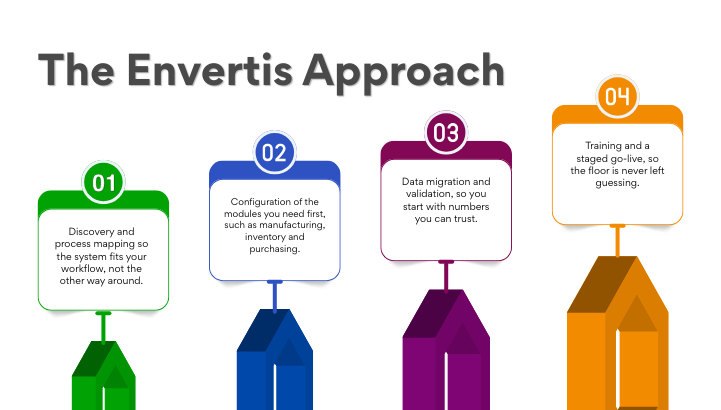
- Discovery and process mapping so the system fits your workflow, not the other way around.
- Configuration of the modules you need first, such as manufacturing, inventory and purchasing.
- Data migration and validation, so you start with numbers you can trust.
- Training and a staged go-live, so the floor is never left guessing.
Phasing matters because rushed rollouts cause budget pain.
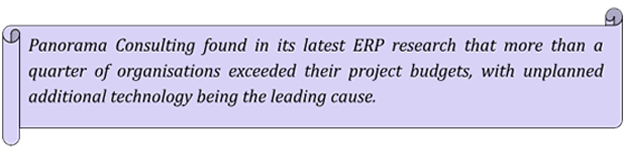
Working with an experienced Odoo ERP partner for manufacturing is the simplest way to avoid that trap.
This is where the right Odoo ERP implementation company earns its keep. The software is capable on its own, but local experience with Australian manufacturers, suppliers, and compliance is what turns a capable platform into results.
Ready to See Where Odoo Fits Your Factory?
If these signs sound familiar, you don’t have to dive in headfirst.
Start with a quick assessment. It’s an easy way to figure out exactly where Odoo can help you most and what a rollout would look like for your business.
Envertis is a certified Odoo Gold partner with over 20 years of ERP experience, and our teams work across Sydney, Melbourne, Brisbane, Adelaide, and Perth. We design our Odoo ERP implementation and consulting services specifically for Australian manufacturers.

Frequently Asked Questions
Q. How do I know when to implement Odoo ERP in manufacturing?
- The clearest trigger is when your team spends more time managing systems than running production. If stock counts never match, planning lives in spreadsheets, or growth keeps adding admin, those are strong signs your manufacturing business needs Odoo ERP.
Q. Is Odoo ERP good for small and mid-sized manufacturers?
- Absolutely. Odoo works like building blocks. You can start small with just the manufacturing and inventory tools you need right now, then add more features as your business grows. That flexibility makes Odoo a good pick if your company isn’t a giant yet.
Q. How long does an Odoo ERP Implementation take?
- Honestly, it depends on your workflow and how many features you want to launch. But for a mid-sized manufacturer, a well-planned, phased rollout usually takes a few months. Rolling out in phases means you keep things running smoothly as you switch systems, so there’s no big hit to production.
Q. What are the main benefits of Odoo ERP for manufacturers?
- The payoffs are pretty clear. You get real-time updates, accurate inventory levels, software that talks to each other, and way less grunt work. That adds up to fewer production hiccups, stronger profits, and a team that can handle more orders without having to hire a bunch of new people.
Q. How much does an Odoo ERP implementation cost?
- There’s no one-size-fits-all price. It all depends on which modules you need, how many people will use the system, and how much you want to customise it to your processes. We start with a quick discovery call, then give you a clear, fixed-price quote, so you know exactly what you’re in for before anything kicks off.
Q. What kind of ROI can manufacturers expect from Odoo ERP?
- The real returns come from four main areas: you do less manual data entry, your inventory is more accurate, production delays drop, and you can make faster decisions because you see what’s going on. Most mid-sized manufacturers see the investment start to pay for itself within the first year, just from saving time on admin and dodging costly stock mistakes.
Q. Why choose Envertis as an Odoo ERP partner for manufacturing?
- With Envertis, you get teams who know Odoo inside and out and actually understand Australian manufacturing. We design your setup to fit how you really work, and since we’re in Sydney, Melbourne, Brisbane, Adelaide, and Perth, support is close by.
