
Revenue leakage is one of the most underestimated threats to business profitability. This blog breaks down the most common revenue leak points for CFOs and business owners, and explains how Odoo ERP closes those gaps through integrated automation.
You approved a project.
The team delivered it.
Suddenly, the client signed off.
Yet when you look at the month-end numbers, the margin is thinner than it should be. No single line explains where the money went.
That gap between the revenue your business earns and the revenue it actually collects is called revenue leakage. And for most growing businesses, it is not the result of bad strategy or weak sales. It is the result of broken processes, unbilled work, delayed invoices, missed contract terms, and data.
Businesses lose between 1% and 5% of annual revenue to leakage, and in service-heavy or project-based models, that figure climbs even higher. Research by EY suggests that every company loses 1% to 5% of realised EBITDA to leakage annually, according to RevenueGrid, and that 42% of businesses experience some form of revenue leakage, according to MGI Research. Wise, for a firm turning over $5 million annually, that is up to $250,000 disappearing quietly each year.
To close this gap, businesses need more than awareness. This blog discusses what businesses need at every stage of the revenue lifecycle.

Where Revenue Leakage Actually Comes From
Before you can fix a problem, you need to locate it. Revenue leakage is not always visible in a single report. It accumulates across multiple touchpoints in the business — each one small enough to overlook, collectively significant enough to matter.
- Unbilled or under-billed work:
When billable hours are not captured in real time, they either go uninvoiced or are conservatively estimated at month-end. Unbilled work is typically the largest single source of leakage, accounting for 40–60% of total revenue leakage in project-based businesses. This is one of the most common and most costly forms of revenue leakage in business.
- Delayed invoice cycles:
Every day between project completion and invoice dispatch is a day you are financing your client’s operations. Across a portfolio of active projects, billing delays create a structural cash flow problem that compounds month over month.
- Contract non-compliance:
Contracted rates, agreed billing milestones, and approved scope boundaries are easy to track manually with two clients. With twenty, the exposure grows. Work delivered outside agreed terms often goes unbilled simply because no one catches it before the invoice is raised.
- Siloed data and manual reconciliation:
When your CRM, project management tool, timesheet system, and accounting platform do not share data, someone is manually connecting them. That process is slow, error-prone, and always a step behind, which means billing decisions get made on incomplete information.
The Financial Case Study of Odoo ERP for SMEs
CFOs evaluating an ERP investment want a clear picture of ROI. Odoo ERP for SMEs delivers it across several measurable dimensions.
Billing cycle compression is typically the first and most visible result. Firms that previously operated on two to three-week billing cycles report moving to weekly cycles after implementation, with a corresponding improvement in days’ sales outstanding and working capital availability.
Project margin visibility changes the nature of financial oversight. When costs, utilisation, and revenue are visible at the project level in real time, you can correct a margin problem mid-project rather than discovering it in a month-end review.
When invoice generation, timesheet reminders, and project status notifications are automated in Odoo, the time previously spent on coordination shifts to billable and strategic work. For a business where senior consultant time is the core revenue-generating asset, that reallocation has a direct financial impact.
Digital transformation with Odoo is not a technology project. It is a financial control project. The platform gives CFOs the data infrastructure to make revenue leakage visible and measurable, and to prevent it, rather than discovering it after the fact through variance analysis.
How Envertis Customises Odoo ERP to Close Each Revenue Gap
Odoo ERP is not a collection of standalone tools loosely assembled under one roof. It is a natively integrated platform where every module, from CRM to invoicing to project management to HR, operates on the same database. That architecture makes it effective for preventing revenue leakage.
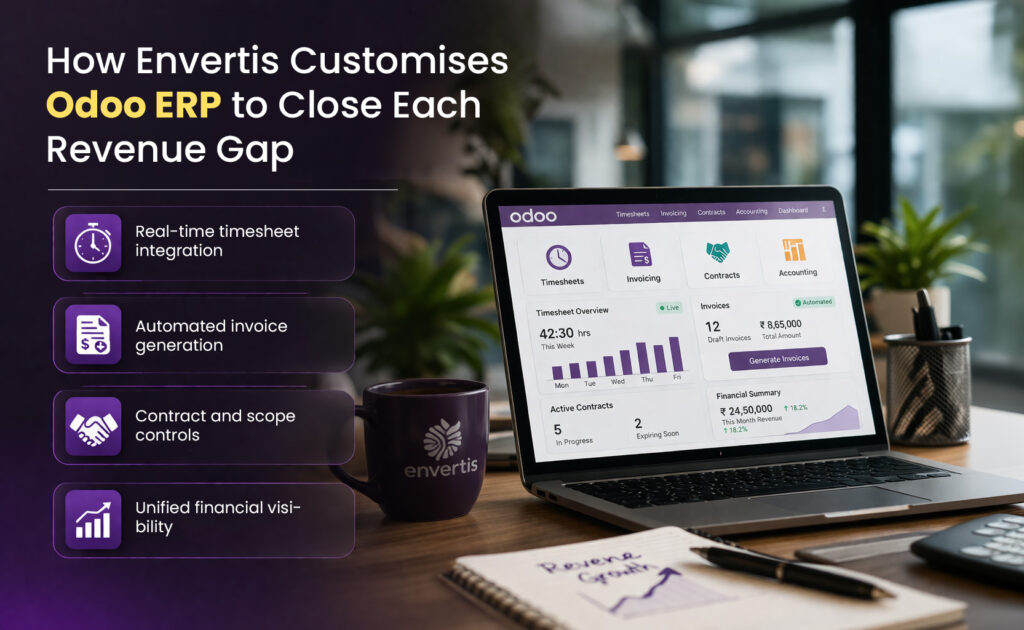
- Real-time timesheet integration:
When consultants and project staff log time directly in Odoo against live tasks, that data flows automatically into the billing module. There is no export, no reconciliation delay, and no version discrepancy between the delivery records and the finance invoices. Business efficiency with ERP ensures the capture-to-invoice path is closed, not approximate.
In practice, this means a senior consultant who logs six hours against a client project on a Thursday afternoon has those hours reflected in the next invoice run automatically — no chasing the project manager for a timesheet, no end-of-month spreadsheet reconciliation, no hours quietly falling off the billing cycle.
- Automated invoice generation:
Odoo supports fixed-fee, time-and-materials, milestone, and retainer billing models within a single system. Invoice triggers can be configured to fire automatically when a task is marked complete, a milestone is approved, or a billing period closes — reducing the manual effort that causes delays and the human oversight gaps that lead to revenue loss.
In practice, this means a project milestone worth $15,000 that gets signed off by the client on a Tuesday generates a draft invoice the same day, rather than sitting in a task manager while the accounts team waits for a weekly handover meeting to find out the work is done.
- Contract and scope controls:
Odoo system integration across the CRM, project, and accounting modules means agreed contract terms travel with a client record from deal closure through delivery. Rate cards, billing limits, and scope boundaries are embedded in the workflow, not stored separately in a document no one checks.
In practice, this means that if a client’s agreed contract is for 40 hours of development at $195 per hour and the project team reaches hour 38, Odoo flags the threshold, giving the account manager time to raise a change order before the work is delivered unbilled, rather than after.
- Unified financial visibility:
Odoo ERP software gives leadership a live view of where revenue sits at every stage. What has been delivered, what has been invoiced, what has been collected, and what is at risk. That visibility is the difference between reacting to a cash flow problem and preventing it.
In practice, this means a CFO reviewing the dashboard on a Monday morning can immediately see that three project milestones totalling $47,000 have been delivered but not yet invoiced — and action those in the same session, rather than discovering the gap during a month-end close three weeks later.

Ready to Recover the Revenue Your Business Is Leaving Behind?
Envertis is a certified Odoo partner with deep implementation expertise across professional services, IT, consulting, and staffing firms. Our approach starts with discovery, mapping exactly where revenue leakage occurs in your operation, and builds from there toward a configured Odoo environment that directly addresses those gaps.
If your business is delivering value, it is not fully capturing it. The starting point is a conversation about where the gaps are and how to close them.
Envertis — ERP implementation company for firms that require more than software.
Frequently Asked Questions
- What exactly is revenue leakage, and how does it affect my business?
Revenue leakage is the gap between the revenue your business earns and the revenue it actually collects. It occurs through unbilled work, delayed invoices, missed contract terms, and disconnected data systems. For a business turning over 5 million dollars annually, leakage can silently cost up to 250,000 dollars every year.
- How does Odoo ERP specifically prevent revenue leakage?
Odoo ERP operates on a single, natively integrated database that connects your CRM, project management, timesheets, and accounting modules. This eliminates manual reconciliation, automates invoice generation, and ensures that every billable hour and milestone is captured and invoiced without delay or gaps in human oversight.
- Is Odoo ERP suitable for small and mid-sized Australian businesses?
Absolutely. Odoo ERP is specifically designed to scale with businesses of all sizes. For Australian SMEs delivering billable work, the platform delivers measurable ROI through billing cycle compression, reduced administrative overhead, and real-time financial visibility — without the enterprise-level licensing costs of platforms like SAP or Microsoft Dynamics.
- How long does a typical Odoo ERP implementation take?
It will hinge on several factors, including the quality of your current data, the number of modules you use (the average is roughly 8), and the complexity of your procedures. If the project’s scope is well-defined, implementing an Odoo system in a small or medium-sized organisation might take anywhere from six to sixteen weeks. Working with a qualified Odoo partner can help you avoid disruptions to your everyday operations and drastically reduce the time required to set up your new Odoo system.
- What are the most common revenue leak points Odoo ERP addresses?
Odoo directly addresses five core revenue leak points: unbilled or under-billed work, delayed invoice cycles, contract non-compliance, siloed data requiring manual reconciliation, and missed subscription or retainer renewals. Each of these gaps is closed through integrated automation and real-time visibility across the platform.
- Can Odoo ERP handle multiple billing models within the one system?
Yes. Odoo supports fixed-fee, time-and-materials, milestone-based, and retainer billing models within a single unified platform. Invoice triggers can be configured to fire automatically upon task completion, milestone approval, or the close of a billing period — removing the manual steps that cause delays and revenue loss.
- What kind of ROI can a CFO expect from an Odoo ERP investment?
According to Nucleus Research, ERP systems deliver an average return of 7.23 dollars for every dollar invested. Businesses implementing Odoo specifically report faster billing cycles, a 25 per cent improvement in financial close times, reduced administrative overhead, and significantly higher forecast accuracy — all of which translate directly into improved cash flow and profitability.
- How does Odoo ERP improve visibility for financial decision-making?
Odoo gives leadership a live view of revenue at every stage — what has been delivered, invoiced, collected, and what remains at risk. This real-time financial visibility allows CFOs and business owners to identify and correct margin problems mid-project rather than discovering them through month-end variance analysis.
